

Views: 0 Author: Site Editor Publish Time: 2026-10-11 Origin: Site
Wheeled excavators provide unmatched mobility for road and utility contractors. You can drive them directly between urban job sites without requiring a specialized transport trailer. However, their pneumatic tires create inherent stability challenges during heavy lifting operations. Many buyers mistakenly believe a machine's operating weight equals its lifting capability. This false assumption routinely leads to dangerous on-site accidents and severe equipment damage.
A 15-ton classification merely defines the physical machine size and gross vehicle weight. It does not dictate maximum payload limits. We designed this guide to give fleet managers an objective framework. You will learn to evaluate the true lifting capacity of a 15 ton wheeled excavator. We thoroughly analyze load charts, outrigger deployment mechanics, and working radius impacts. By mastering these principles, your team can prevent tipping risks and maximize daily productivity safely.
Machine Class vs. Lift Capacity: A 15-ton operating weight dictates machine size, not the maximum payload; actual lift capacity is a fraction of this weight.
The Tipping Line: Lifting "over the side" reduces capacity by up to 40% compared to lifting "over the front/rear" unless outriggers are fully deployed.
Radius is the Ultimate Filter: As the load radius increases (distance from the swing center), capacity drops exponentially due to leverage physics.
ISO Standards Rule: Reliable manufacturers rate lift capacities based on ISO 10567—limited to 75% of the tipping load or 87% of the hydraulic limit.
The construction industry often categorizes equipment by gross vehicle weight (GVW). When you hear "15-ton class," this number represents the physical weight of the machine itself. It includes the chassis, boom, counterweight, and fluids. It does not indicate the weight the machine can suspend from its bucket pin.
Procurement teams frequently fall victim to the "over-promising" risk. Sales brochures sometimes highlight maximum theoretical hydraulic lift. These theoretical numbers often ignore real-world stability constraints. Buying a machine based purely on hydraulic force invites operational disaster. Structural stability always dictates safe lifting limits before hydraulic power maxes out.
Operators must understand baseline capabilities for this weight class. A typical 15-ton machine handles specific materials when positioned correctly. Safe working loads usually range between 3,000 kg and 5,000 kg under optimal conditions.
Typical Safe Lifting Applications:
Maneuvering standard steel trench boxes into excavations.
Placing heavy concrete road barriers along highway shoulders.
Lowering large-diameter drainage pipes into utility trenches.
Unloading palletized materials from delivery trucks.
Common Mistake: Never assume a larger bucket increases lifting capacity. Oversized buckets add dead weight to the end of the stick. This extra attachment weight actively subtracts from your available payload capacity.
Working radius serves as the ultimate filter for lifting operations. We define working radius as the horizontal distance from the machine's axis of rotation to the vertical lifting point. You measure this from the exact center of the swing bearing outward.
Basic physics governs every lift. The machine acts as a giant seesaw. The swing center acts as the fulcrum. The counterweight provides the effort, and the suspended load creates the resistance. Because of this leverage, the multiplier effect takes over. Doubling your load radius effectively halves your safe lifting capacity. A 4,000 kg capacity at a 3-meter radius might drop to just 1,800 kg at a 6-meter radius.
Boom configurations heavily influence this dynamic. Manufacturers primarily offer two distinct boom styles for wheeled machines.
Boom Type | Design Mechanics | Lifting Advantages | Best Application |
|---|---|---|---|
Mono-Boom | Single solid piece from base to articulation joint. | Lighter overall weight, simpler maintenance. | Standard trenching, open-space lifting. |
Two-Piece (Articulated) | Features an extra pivot point mid-boom. | Allows operators to tuck loads closer to the cab. | Tight urban corridors, heavy close-quarter lifts. |
A two-piece boom allows the operator to pull the load much closer to the machine's center of gravity. This dramatically reduces the working radius. Reducing the radius maximizes the actual lift capacity. This feature proves invaluable when lifting heavy barriers in single-lane traffic zones.
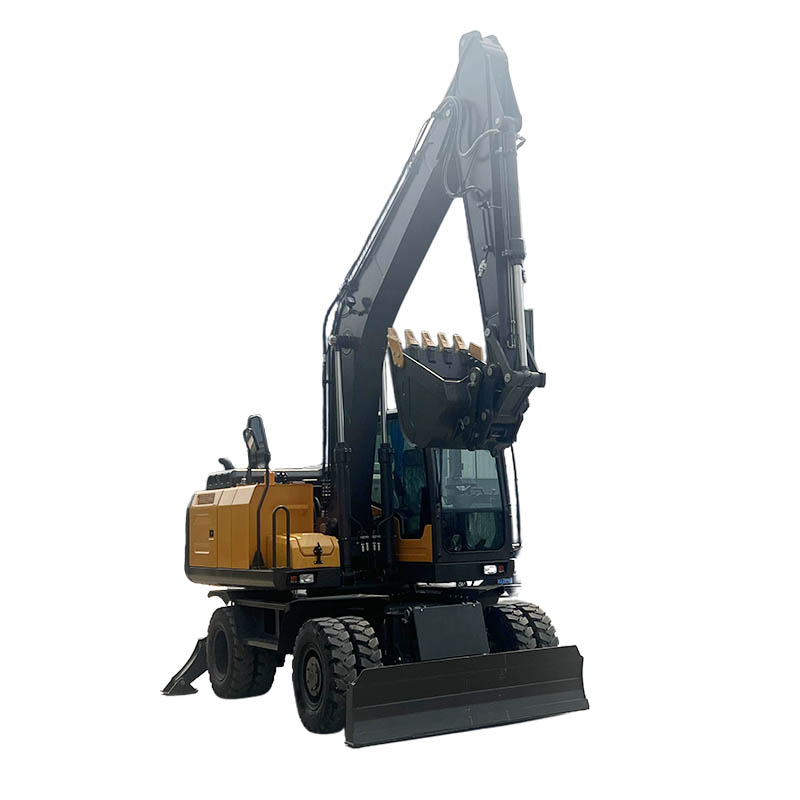
Solid ground provides a stable lifting platform. Pneumatic tires do not. Tires act as a flexible pivot point. When you lift a heavy load, tires compress. The machine's suspension also compresses. This combined flexing creates a bounce effect. Suspension bounce multiplies the dynamic forces acting on the machine, rapidly accelerating tipping risks.
Independent outrigger deployment solves this problem entirely. Deploying outriggers shifts the machine’s fulcrum away from the tires. It widens the overall footprint significantly. Outriggers bypass the flexible rubber and suspension. They transfer load forces directly into the solid earth below.
Most operators utilize the rear dozer blade as a primary stabilizer. The dozer blade offers a massive surface area. Using the rear dozer blade in tandem with front outriggers creates a rigid, four-point stance. This four-point stance eliminates axle oscillation completely.
When fleet managers evaluate 13–18T Wheel Excavator models, they must assess specific stabilizer features. Simply having outriggers is not enough. You must inspect the outrigger width when fully deployed. Wider stances offer exponentially better lateral stability. You must also check for robust cylinder protection. Outrigger cylinders face constant exposure to job site debris. Finally, evaluate the pad surface area. Larger pads distribute weight better on soft soils.
Best Practice: Always lift the tires entirely off the ground when setting up for a maximum-capacity lift. The tires should bear zero weight during the operation.
Every operator must understand how to read a load chart. These charts live inside the cab for a reason. They dictate the strict boundaries of safe operation. Two primary constraints govern these numbers: hydraulic limits and tipping limits.
Hydraulic limits occur when the boom simply will not lift the load. The hydraulic relief valves open to prevent structural damage. Tipping limits occur when the machine will physically tip over before the hydraulics stall out. Tipping limits present a much higher safety risk.
Reliable manufacturers rate their capacities based on the ISO 10567 standard. This global standard builds in mandatory safety margins. It limits published capacities to either 75% of the tipping load or 87% of the hydraulic limit. The chart displays whichever number is lower.
You must learn to decode the asterisk (*). Load chart figures featuring an asterisk typically denote hydraulic limits. Figures lacking an asterisk denote tipping limits. This visual cue tells the operator exactly how the machine will fail if overloaded.
Over-front versus over-side discrepancies define wheeled machine operations. Lifting directly over the front dozer blade offers maximum stability. Swinging that same load 90 degrees over the side changes the physics entirely. The footprint narrows dramatically. Over-the-side ratings represent the true test of a wheeled excavator's stability. Capacity often drops by 30% to 40% the moment you swing over the tires.
Even the best machine fails on terrible ground. Site evaluation determines lift success before you ever attach a chain. Ground Bearing Pressure (GBP) represents the most critical metric. A fully loaded 15-ton machine exerts immense pressure through its outrigger pads.
Deploying outriggers on uncompacted soil invites disaster. The soil will shear under the pad. Hot asphalt presents similar implementation risks. Summer heat softens asphalt. The point-load of an outrigger can punch straight through a newly paved road. Lifting near trench edges also risks collapsing the excavation wall entirely.
Operators must utilize engineered outrigger pads or timber mats. These accessories distribute the extreme point-load over a wider surface area. Distributing the weight prevents the stabilizers from sinking during a maximum-capacity lift.
Essential Site Evaluation Steps:
Inspect the soil composition and compaction levels.
Measure the ground slope using a digital level.
Calculate the required distance from any trench edges.
Place engineered outrigger pads under all contact points.
Deploy stabilizers until the tires clear the ground.
All published load charts assume ideal conditions. The standard assumes the machine sits on firm, level ground. Industry guidelines define "level" as being within 1 degree of absolute flat. Operating on a slope invalidates the printed load chart entirely. Slopes shift the machine's center of gravity downhill, drastically reducing safe capacity.
Fleet managers face a persistent dilemma: tracked versus wheeled machines. You must summarize your evaluation criteria based on daily applications. If your jobs require constant heavy lifting on soft mud, a crawler excavator wins. Tracks distribute weight naturally over a massive area. However, urban utility work demands different capabilities.
If your team requires lifting concrete barriers on finished pavement, wheels win. If you need to drive the machine three miles to the next site, wheels win. The wheeled excavator eliminates transport trailer costs and logistics entirely.
Specifying the right build ensures long-term safety. When shortlisting a 15 ton wheeled excavator, buyers must demand specific features. Ensure the machine features heavy-duty axles. Standard axles can bend under repetitive heavy static loads. Dual tires offer significantly better lateral stability than single super-wide tires.
Load-holding valves represent a mandatory safety requirement. Industry professionals often call these hose burst check valves. They mount directly on the boom and dipper cylinders. If a high-pressure hydraulic hose blows during a lift, these valves lock the cylinder in place. They prevent the suspended load from crashing to the ground.
Your next-step actions dictate your purchasing success. Calculate your heaviest anticipated load. Determine the maximum required radius to place that load. Demand a scenario-specific load chart review during your dealer demonstration. Do not accept vague verbal promises regarding lifting limits.
The true value of a wheeled excavator lies in its unparalleled urban versatility. Operators can drive to a site, lift heavy pipe, backfill the trench, and drive home. However, you maintain this versatility only if operators strictly adhere to radius and outrigger constraints. Bypassing safety protocols to save time inevitably leads to costly tipping accidents.
We recommend basing all purchasing decisions on your worst-case scenario lift. Plan for the maximum radius. Plan for lifting over the side. Plan for lifting on tires without stabilizers. If the machine handles your worst-case scenario safely, it will excel during standard operations. Never base a purchase on the best-case spec sheet headline.
Take action today by reviewing your current job site lifting requirements. Consult with your technical sales team to analyze specific load charts. Request a live stability demonstration to see the equipment in action. You can explore specialized configurations of a 13–18T Wheel Excavator to ensure your fleet meets all upcoming project demands safely.
A: Yes, but capacity is severely restricted. Lifting on rubber often reduces safe capacity by 50% or more. This method relies entirely on proper tire pressure, engaging axle oscillation locks, and lifting directly over the front chassis to maintain basic stability.
A: While highly dependent on the working radius and attachment weight, most machines in this class max out between 3,000 kg and 5,000 kg. You only achieve these numbers at a very close radius with all stabilizers firmly planted on level ground.
A: They act as a critical safety net. Also known as hose burst check valves, they prevent the boom or arm from collapsing if a hydraulic line fails suddenly. They lock the fluid inside the cylinder, keeping the suspended load safely in the air.


