

Views: 0 Author: Site Editor Publish Time: 2026-10-01 Origin: Site
Buying compact machinery often involves a tough compromise. You need a machine small enough to fit through tight residential gates. Yet, you also require enough muscle to dig trenches quickly. Balancing digging depth and site access remains a core dilemma for buyers today. A 1.8 ton mini excavator represents the industry sweet spot for residential contractors, landscapers, and utility workers. However, buyers often confuse the absolute maximum depth printed in brochures with functional flat-bottom trenching depth achievable in real-world soil. In this guide, we explore the true capabilities of these versatile compact machines. You will discover practical job limits, baseline reach specifications, and actual breakout force expectations. We also evaluate critical fleet sizing options so you can choose the right equipment confidently for your upcoming projects.
Max Digging Depth: Typically ranges from 7 ft to 8 ft (2.1m to 2.4m), heavily dependent on standard vs. long-arm configurations.
Operational Sweet Spot: Ideal for utility trenching, shallow foundations, and landscaping; struggles with deep rock excavation or heavy mass grading.
Logistical Advantage: At 1.8 tons (approx. 3,600 lbs), it can be easily towed behind standard heavy-duty pickup trucks without specialized commercial transport permits (region-dependent).
Shortlisting Criterion: If your primary jobs require frequent digging past 6.5 feet with flat-bottom precision, a larger 2.5T to 3T class may offer better cycle times.
To evaluate equipment capabilities accurately, we must look beyond basic marketing claims. Understanding the exact mechanical limits helps you avoid renting or buying an underpowered machine.
Manufacturers measure digging depth at the lowest point the bucket teeth can reach. A standard arm typically reaches down about 7 feet. If you opt for a long-arm configuration, you gain an extra 8 to 12 inches of depth. However, longer arms slightly reduce your overall breakout force due to altered leverage geometry.
You must also differentiate between absolute maximum depth and vertical wall depth. True vertical digging depth is usually 1.5 to 2 feet less than the absolute max reach. If you need a perfectly vertical 6-foot trench wall for concrete forms, a machine rated for a 7-foot maximum depth will likely fall short.
Ground-level reach usually measures between 12.5 and 13.5 feet. This metric heavily dictates your daily productivity. Exceptional ground reach means you reposition the machine less often. Staying stationary longer improves your cycle time efficiency significantly. It also keeps operators focused on digging rather than constantly lifting the blade and tracking forward.
A typical dump height for this weight class hovers around 8.5 to 9 feet. This vertical clearance determines what type of vehicles you can load. This height comfortably clears the sides of standard dump trailers. It also works perfectly for small tipper trucks. If you plan to load high-sided tandem-axle dump trucks, you will likely need a loading ramp or a larger excavator.
Breakout force translates hydraulic pressure into raw digging power. We measure this force in kiloNewtons (kN). Bucket breakout force generally reaches about 15 to 16 kN. Meanwhile, the arm breakout force usually rests between 9 and 10 kN. This combined force determines your ability to penetrate compacted clay, sever thick roots, or push through winter frost lines.
Specification Category | Standard Measurement Range | Real-World Impact |
|---|---|---|
Maximum Digging Depth | 7.0 ft - 8.0 ft | Determines suitability for deep utility trenches. |
Vertical Wall Depth | 5.0 ft - 6.0 ft | Crucial for foundations and retaining wall construction. |
Ground Level Reach | 12.5 ft - 13.5 ft | Dictates tracking frequency and overall cycle times. |
Dump Height Clearance | 8.5 ft - 9.0 ft | Defines compatibility with standard dump trailers. |
Bucket Breakout Force | 15 kN - 16 kN | Indicates raw power for tearing through hard soils. |
Knowing the mathematical specifications is only half the battle. You must understand how these numbers translate to actual job sites. Every machine has a specific operational sweet spot.
A 1.8T Mini Excavator truly excels in shallow to medium excavation tasks. Utility installations represent the most common use case. Burying water lines, laying electrical conduits, and installing fiber optics usually require 3-to-4-foot trenches. This depth sits perfectly within the machine's most efficient power band.
These units also dominate residential foundation footings. They easily excavate prep zones for retaining walls. Furthermore, they excel in confined-space landscaping. If you need to remove medium-sized stumps or run backyard irrigation lines, this machine maneuvers effortlessly around existing structures.
Pushing this machine to its absolute limits decreases efficiency. Trenching at the maximum rated depth of 7+ feet slows cycle times drastically. The operator must dig cautiously to avoid collapsing the trench walls. Machine instability also becomes a factor at full arm extension. You must position the front dozer blade carefully to anchor the chassis.
Lifting heavy materials serves as another marginal application. Operators sometimes try to lower large concrete manholes or heavy trench boxes into place. However, lifting capacity drops significantly when you swing the boom over the side. Extending the arm fully also severely reduces safe load limits.
You must recognize when a job requires heavier equipment. Avoid continuous heavy rock breaking. Extended hydraulic breaker use strains the undercarriage. It also pushes the auxiliary hydraulic flow limits to dangerous heat levels.
High-volume bulk earthmoving is another hard limit. If a project requires moving hundreds of cubic yards of dirt, the bucket capacity remains too small. Your cycle times will stretch endlessly. This inefficiency destroys any chance of a profitable return on investment.
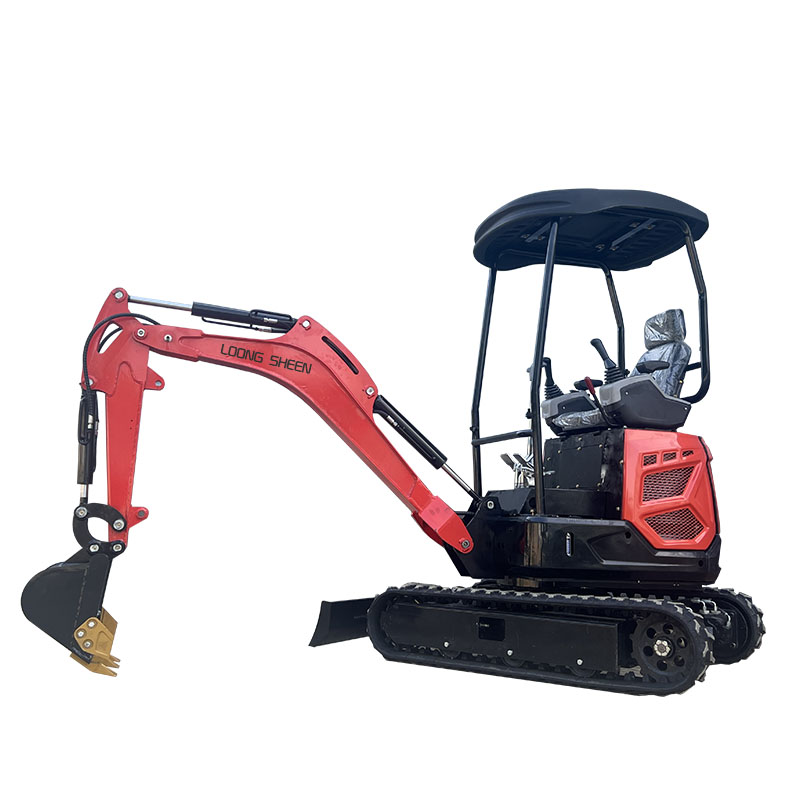
Contractors often debate whether to size up or size down. Choosing the correct tonnage directly impacts your daily operational logistics.
When comparing ultra-compact models, footprint width matters most. A 1.2T model can often fit through standard 36-inch residential doorways. This makes them ideal for indoor demolition. Conversely, a 1.8 ton mini excavator usually requires a 40-inch minimum clearance. This applies even when equipped with retractable tracks.
However, the slightly larger model offers far superior stability. It provides significantly higher tail-swing balance and breakout force. This extra weight anchors the machine firmly. Better stability drastically reduces operator fatigue during long, multi-day trenching jobs.
Moving up to a 3-ton machine introduces complex towing logistics. A 1.8T machine paired with a standard equipment trailer stays well under the typical 10,000 lb towing threshold. You can easily pull it using a standard heavy-duty pickup truck.
In contrast, a 3T machine often pushes you into commercial licensing territory. You might need a CDL or upgraded fleet vehicles just to transport the equipment. You must weigh the higher upfront acquisition cost against the actual output. Often, a 3T machine only provides an extra 1 to 1.5 feet of digging depth.
Measure Your Access Points: Survey the average gate width of your typical residential job sites before purchasing.
Check Towing Capacities: Verify the Gross Combined Weight Rating (GCWR) of your current fleet trucks.
Audit Past Projects: Review your last year of work. Note how many jobs actually required digging deeper than 6 feet.
Assess Transport Routes: Determine if your region enforces strict commercial transport regulations for heavier trailers.
An excavator is only as useful as the tools you attach to it. Understanding hydraulic limits ensures you purchase compatible, high-yield accessories.
Compact excavators utilize auxiliary hydraulic circuits to power attachments. A standard 1.8T Mini Excavator typically delivers auxiliary flow rates between 7.5 and 9 GPM (Gallons Per Minute). This equates to roughly 28 to 34 LPM (Liters Per Minute). This flow rate comfortably runs most standard residential attachments without overheating the hydraulic fluid.
Trenching Buckets (8" - 12"): Narrow buckets maximize utility job speed. They remove only the dirt necessary for small pipes, saving backfill time.
Augers: These attachments provide optimal drilling capabilities for fencing and deck footings. They operate smoothly without maxing out hydraulic pressure limits.
Hydraulic Thumbs: A thumb attachment is essential for debris handling. It transforms the machine into a multi-tool for brush clearing and minor demolition work.
Versatile attachments prevent your machine from sitting idle in the yard. An idle machine generates zero revenue. By swapping a trenching bucket for an auger, you can complete two distinct phases of a single project. This multi-functionality directly accelerates the break-even point for owner-operators.
Moving equipment safely from the yard to the job site requires careful planning. Proper maintenance and logistical awareness prevent costly downtime.
You must calculate your total transport weight accurately. Never look solely at the machine's operating weight. A proper calculation includes the machine itself (roughly 3,600 lbs), the weight of three extra buckets, the hydraulic thumb, and the heavy-duty trailer frame. Ensure your trailer axles rate high enough to support this combined payload. Balance the weight evenly over the axles to prevent dangerous trailer sway on the highway.
Consider ground pressure before tracking across a client's property. Rubber tracks distribute weight efficiently, minimizing severe turf damage on soft residential lawns. You should also evaluate tail swing designs. Zero-tail-swing (ZTS) models keep the rear housing within the width of the tracks. This prevents operators from accidentally smashing the counterweight into fences or brick walls while rotating.
Consistent upkeep ensures maximum reliability in the field. Small-chassis excavators have specific routine wear points. Undercarriage track tensioners require frequent checking, especially after working in deep mud. Track wear accelerates quickly in rocky soil conditions.
You should also evaluate the accessibility of service points. A well-designed compact model features an accessible engine bay layout. Mechanics and operators need unhindered access to oil dipsticks, air filters, and hydraulic fluid sight glasses. When daily checks are easy to perform, operators rarely skip them.
The 1.8 ton mini excavator remains a specialized tool optimized for shallow-to-medium utility and landscaping work. It is not designed for continuous bulk excavation or heavy quarry rock breaking. Its true value lies in its balanced design. It offers enough breakout force to handle compacted clay while remaining light enough for straightforward, non-commercial transport.
We advise buyers to audit their past twelve months of jobs carefully. If 80% of your trenching tasks fell under 6 feet deep, this compact weight class provides the highest operational efficiency and transport ease.
As your next step, compare manufacturer spec sheets closely. Request a localized dealer quote for your preferred configuration. Finally, schedule an on-site demo to test the machine's true breakout force in your specific local soil conditions.
A: Yes, it can easily remove small to medium stumps up to 12-15 inches in diameter. Larger stumps require significant root trenching around the perimeter and may strain the machine's breakout force. You should use a ripper tooth attachment for optimal root-cutting results.
A: Most models feature retractable undercarriages. Widths typically range from roughly 39 inches when fully retracted to 51 inches when expanded for digging stability. This allows them to pass through standard 40-inch landscaping gates easily.
A: In most regions, no. The combined weight of the excavator (approx. 3,600 lbs) and a standard equipment trailer is generally well below commercial licensing thresholds. However, local DOT regulations vary, so you should always verify local towing weight limits.
A: Lifting capacity varies wildly based on boom position and track orientation. Over the front with the dozer blade down, it may lift 1,000+ lbs. However, over the side at full reach, capacity can drop to 400 lbs or less. Always consult the specific manufacturer's load chart.


