

Views: 0 Author: Site Editor Publish Time: 2026-07-05 Origin: Site
Operating in mud, steep gradients, or confined, uneven spaces immediately exposes the limitations of wheeled machinery. You lose traction quickly. Projects grind to a sudden halt. Finding a reliable small-footprint machine is easy. Finding a factory-direct partner capable of delivering durable, low-maintenance units at scale requires strict vetting. Procurement teams often struggle to separate genuine manufacturing capability from clever marketing. Manufacturers frequently make bold claims. You need concrete data to make smart purchasing decisions. This guide outlines the technical and operational criteria for evaluating a mini crawler dumper oem. We will help you bypass marketing claims. You will learn how to shortlist manufacturers based on engineering quality, operational readiness, and post-sale support. Fleet managers can use this framework to secure machinery built for actual job site abuse.
Traction vs. Ground Pressure: The primary value of a rubber track dumper is distributing payload weight to prevent rutting and maintain traction on slopes exceeding 20 degrees.
OEM Vetting is Critical: A high-quality machine is a liability without a robust OEM partner offering guaranteed parts availability, transparent lead times, and clear warranty terms.
Hydraulics Over Horsepower: For rough terrain, hydraulic pump reliability and undercarriage build quality dictate lifespan more than sheer engine output.
Match Payload to Site Constraints: Over-specifying capacity increases track wear and fuel costs; models should be evaluated based on the specific bottleneck of the target job site.
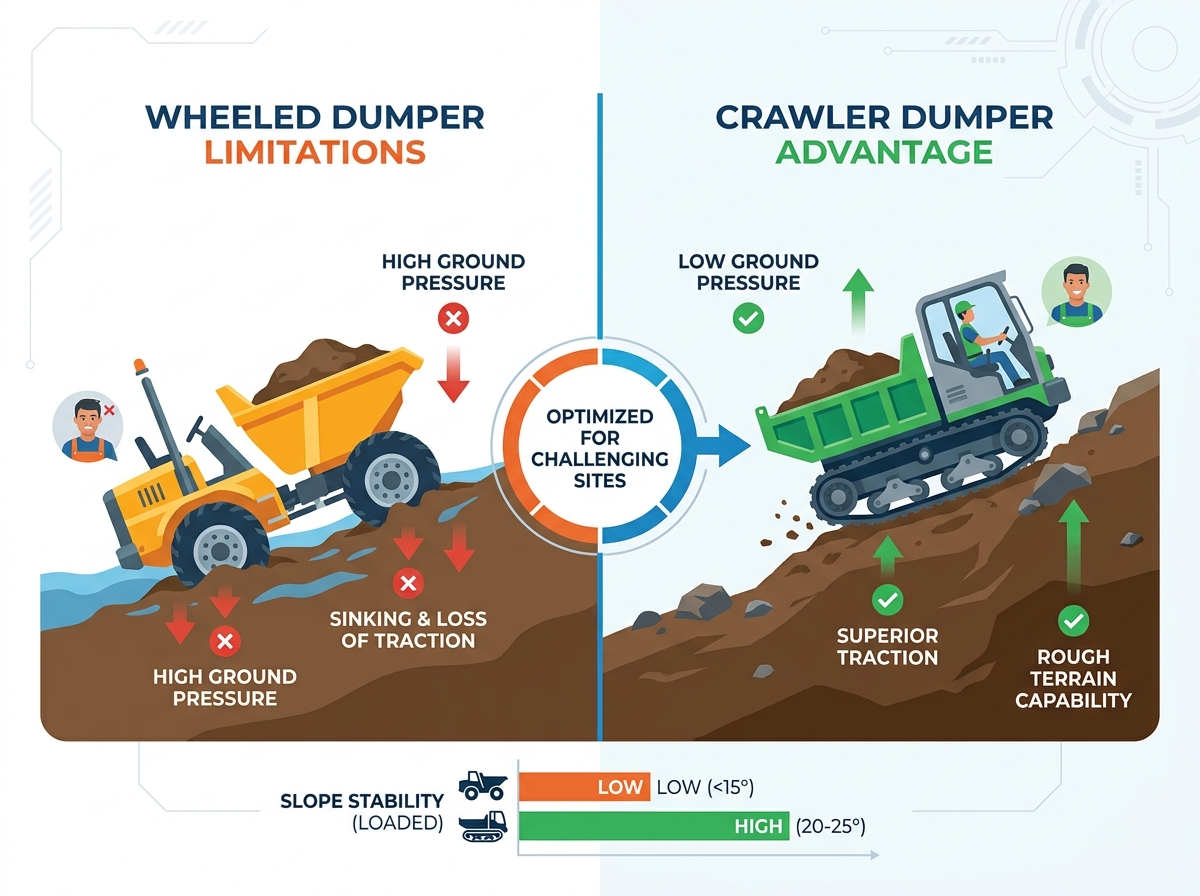
Wheeled dumpers fail frequently in wet, muddy, or highly uneven conditions. They apply immense pressure to a tiny surface area. This high ground pressure causes tires to slice through soft topsoil. The machine sinks. Operators quickly lose traction. A tracked machine solves this problem completely. It spreads the vehicle weight across a wide, continuous surface. This flotation effect prevents sinking. The tracks maintain continuous ground contact over deep ruts and sharp rocks.
You must clearly define the operational footprint of your equipment. A true small site dumper excels in restricted spaces. It navigates narrow access points seamlessly. These machines easily pass through residential gates under 36 inches wide. They carry payloads equivalent to ten manual wheelbarrow trips. You eliminate backbreaking labor. You dramatically accelerate project timelines in confined urban sites.
We must establish strict baseline requirements for rough terrain capability. True off-road performance demands a high minimum ground clearance. A low center of gravity is absolutely non-negotiable. Aggressive approach and departure angles prevent the machine from bottoming out on steep transitions. You cannot rely on visual inspections alone.
Instruct your procurement team to request empirical testing data from prospective partners. Ask for specific slope stability metrics. Compare the incline limits of a fully loaded machine against an unloaded one. Many manufacturers rely on blanket "all-terrain" marketing claims. You should reject these vague statements. Demand documented engineering reports outlining maximum safe operating angles.
You must scrutinize the mechanical foundation of any tracked transport dumper before placing bulk orders. The undercarriage and track system bear the brunt of operational abuse. Focus intensely on the quality of the rubber track dumper mechanism. Evaluate the bogie wheel construction carefully. Cast steel wheels outlast stamped steel alternatives significantly. Stamped wheels bend under heavy side-loading. Next, examine the track tensioning system. Grease cylinder tensioners adjust easily in the field. Mechanical bolt systems often rust and seize. Pay close attention to the track pitch. A shorter pitch ensures a smoother ride over abrasive terrain.
Engine and powertrain selection determines daily reliability. You must assess engine origins closely. EPA and Euro V compliance is strictly non-negotiable for Western markets. Non-compliant units face immediate customs rejection. Compare transmission options based on your labor pool. Hydrostatic drives offer infinitely variable speed control. They require minimal training. Operators find them much easier to maneuver on slopes. Mechanical gearboxes cost less upfront. However, they suffer accelerated wear under heavy load shifting. Inexperienced operators frequently burn out clutches.
Hydraulic system integrity separates professional equipment from hobbyist toys. Examine hydraulic cylinder placement thoroughly. Designers must protect cylinders from falling debris and side impacts. Exposed rods scratch easily. Scratched rods destroy seals rapidly. Evaluate the hydraulic pump brands and their maximum flow rates. Sluggish bucket movement under a full load indicates an under-specced pump. High-quality pumps deliver consistent pressure all day.
Dump box design requires equal attention. Assess the steel plate thickness. Inspect the welding quality across all major stress points. Compare standard tip mechanisms against high-tip scissor lifts. Match the design to your end-user application. High-tip models load materials directly into tall skips. Standard tip models work best for simple ground dumping.
Here is a technical comparison of drive systems for tracked models:
System Type | Operational Ease | Durability on Slopes | Maintenance Needs | Best Application |
|---|---|---|---|---|
Hydrostatic Drive | High (Clutch-free operation) | Excellent | Requires regular fluid/filter changes | Rental fleets, novice operators |
Mechanical Gearbox | Moderate (Requires shifting) | Average | Frequent clutch adjustments | Owner-operators, budget constraints |
You must align machine specifications with actual field applications. Over-speccing wastes capital. Under-speccing destroys equipment. Structure your evaluation around distinct payload categories.
These lightweight units excel in landscaping, interior demolition, and residential hardscaping. They navigate tight indoor corridors and delicate lawns. Demand a machine width under 800mm. This dimension guarantees safe passage through standard doorways. Look for folding operator platforms. These platforms reduce the overall machine length during transport. Mechanical drive systems generally suffice here. The lighter payloads put less stress on the gearbox.
Heavy civil construction sites and forestry applications demand this category. Operators move wet concrete or heavy timber over deep mud. You must specify a hydrostatic transmission for these tasks. Fluid-driven tracks handle heavy torque loads smoothly. Insist on a diesel engine. Diesel provides the low-end grunt needed for steep, muddy inclines. Demand a heavily reinforced undercarriage. Ride-on capability is mandatory for operator safety during long transport cycles.
Municipal fleet buyers and massive rental houses require maximum utilization rates. A single-purpose machine sits idle too often. An off-road dump truck with a modular chassis solves this problem. Demand robust quick-attach systems. Operators can swap the standard dumper bed for flatbeds, snow plows, or wood chippers in minutes. You must require auxiliary hydraulic outputs. These ports power external attachments directly from the primary pump.
A brilliant spec sheet means nothing if the supplier cannot deliver. You must verify manufacturing transparency immediately. Determine if you are communicating with a true factory or merely a trading company. Trading companies mask their identities well.
Follow these specific verification steps:
Request updated, verifiable factory ISO 9001 certifications.
Ask for live video tours of the welding and assembly lines.
Inquire about the exact size and structure of their internal engineering team.
Demand documented quality control checklists for outbound containers.
Evaluate the manufacturer's customization and white-labeling capabilities. You might want to build your own local brand. Assess their ability to modify paint codes and apply custom safety decals. Ask if they can swap generic engines for trusted brands like Honda, Kubota, or Briggs & Stratton. Clarify their Minimum Order Quantities (MOQs) for these modifications. Some factories require massive volumes for simple engine swaps.
Analyze supply chain realities closely. You need realistic production schedules. Discuss shipping logistics upfront. Calculate exact port-to-door timelines based on current global shipping constraints. Delays cost money. A reliable partner provides transparent weekly production updates.
Warranty and parts infrastructure define a successful long-term partnership. A standard one-year warranty is baseline. The critical metric is warranty execution. Determine the factory's willingness to ship replacement parts via air freight during the warranty period. Some suppliers offer warranties but insist on shipping small parts via slow ocean freight. This leaves your machine broken for months. Demand air freight commitments for critical warranty components.
Deploying tracked equipment introduces specific physical realities you must manage. Rubber tracks are highly consumable items. They will wear down. The rate of wear depends entirely on operator behavior. Improper maneuvers destroy tracks quickly. Counter-rotating the machine on sharp rocks tears rubber lugs instantly. Operators must execute gradual, sweeping turns on abrasive surfaces.
Daily maintenance routines dictate machine survival. Track tension requires daily verification. Loose tracks derail easily on slopes. Over-tightened tracks destroy drive sprockets and hydraulic wheel motors. Operators must grease all pivot points at the start of every shift. Proper hydraulic fluid management prevents catastrophic pump failures. Contaminated fluid scores cylinder walls.
Operator adoption varies based on the control scheme. Hydrostatic models present a very low barrier to entry. Unskilled laborers learn to drive them safely in minutes. You simply push a lever to move forward. Mechanical gearbox models require clutching and rev-matching. You must factor these operational differences into your site training programs.
Shortlisting suppliers requires a disciplined approach. Never commit to a multi-unit bulk order based on photos. Advise your procurement team to order a single sample unit first. Subject this unit to severe, destructive field testing. Load it past its rated capacity. Drive it on extreme slopes. Measure hydraulic temperatures after continuous use. This single test unit exposes manufacturing flaws before you risk substantial capital.
Selecting the right factory partner requires balancing upfront unit pricing with long-term mechanical durability. You cannot compromise on undercarriage strength or hydraulic reliability. Weak components fail rapidly on rough terrain sites. You must move beyond basic marketing brochures and analyze actual engineering data.
Prioritize manufacturers offering total component transparency. They should proudly display their use of name-brand engines and premium hydraulic pumps. The best suppliers willingly provide detailed technical drawings. They back their products with highly responsive, air-freight-enabled parts support.
Take immediate action on your shortlist. Contact your selected factories directly. Request a comprehensive formal spec sheet for your target model. Ask for their specific MOQ requirements for white-labeling. Finally, demand a landed quote for a single sample unit shipped to your nearest commercial port. Start your field testing process today.
A: You must distinguish between empty and fully loaded limits. Typically, 20 to 25 degrees is the safe maximum incline when fully loaded. Some manufacturers falsely claim limits up to 30 degrees. Always rely on the factory's official engineering load chart rather than sales brochures.
A: Track lifespan varies significantly based on surface conditions and operator skill. You can generally expect between 400 and 800 operating hours. Abrasive rock surfaces and aggressive counter-rotating drastically reduce this lifespan. Soft mud and gentle sweeping turns extend it.
A: Yes. Most legitimate factories offer extensive customization options. You can request flatbeds, extended side panels, or specialized high-tip buckets. You will typically need to meet the factory's Minimum Order Quantity (MOQ) to qualify for these structural modifications.
A: Hydrostatic systems use hydraulic fluid to drive the track motors. They offer smooth, clutch-free operation and easy maneuvering. Mechanical systems use a traditional gearbox and belts. Mechanical drives cost less to purchase and repair, but they are physically harder on the operator.


