

Views: 0 Author: Site Editor Publish Time: 2026-08-12 Origin: Site
Narrow construction sites create major operational bottlenecks. Backyard renovations, indoor demolition, and urban landscaping often lack standard equipment access. Relying on manual labor like wheelbarrows quickly drains project profitability. Selecting the wrong equipment causes severe property damage and operational delays. Standard machines easily become stranded assets when they cannot clear typical access gates. You lose valuable time trying to squeeze oversized gear into tight spaces. Contractors face constant pressure to move heavy materials safely. Finding the perfect balance between machine size and payload capacity solves this challenge. We need a reliable approach to navigate these restrictions effectively. This guide provides an evidence-based framework for evaluating exact specifications, drive types, and operational constraints. You will learn exactly how to choose the right Mini dumper for your specific job site. Let us explore the critical factors guiding your next equipment decision.
Access width dictates your baseline; always measure the narrowest choke point (doors, gates, alleys) before looking at payload capacity.
Tracked models excel on soft ground and steep gradients, while wheeled models offer faster transit times on hard, flat surfaces.
Matching your mini dumper's payload and tipping mechanism to your loading equipment (like a mini excavator) is critical for workflow efficiency.
Before browsing equipment catalogs, you must evaluate your physical job site. Site constraints dictate your equipment baseline. We must break down the essential measurements to ensure your machinery fits perfectly.
Standard residential gates and doorways typically range from 30 to 36 inches wide. This narrow passage serves as your primary filter. Machine width represents the definitive metric for shortlisting equipment. Compact models usually measure between 28 and 34 inches. You must physically measure the narrowest choke point on your site. Do not guess these dimensions. Measure the clear opening, accounting for hinges and latch hardware. Always check overhead clearances too. Low-hanging branches or indoor doorframes easily block roll-over protection structures (ROPS).
Surface conditions heavily influence equipment selection. Hard surfaces like concrete or asphalt demand specific tire setups. Sensitive or soft ground requires a gentle approach. Mud, wet turf, and indoor flooring react differently to heavy machinery. Ground bearing pressure (GBP) determines surface impact. Lower GBP prevents deep ruts and surface damage. High GBP focuses machine weight onto small contact patches. This increases traction on hard surfaces but causes sinking in mud. You must assess whether your site requires protective mats or low-impact tracks.
Evaluate all site inclines carefully. Moving heavy materials up or down slopes introduces severe tipping hazards. Narrow paths often feature uneven terrain. Sloped ground shifts the machine's center of gravity. You must match the equipment's gradability rating against your steepest incline. Manufacturers specify safe operating angles. Exceeding these limits risks operator injury and material spills. Always map out the transport route beforehand. Identify lateral slopes where the machine might lean sideways during transit.
Use a laser measure for accurate gate widths.
Walk the entire transport path to identify hidden dips.
Check soil moisture levels to predict sinking risks.
Identify fragile underground utilities before driving over them.
Your terrain dictates the necessary drive type. Contractors must choose between wheeled and tracked models. Each design offers distinct operational advantages. Matching the drive system to your environment prevents costly delays.
Wheeled models dominate hard, flat environments. They perform exceptionally well on concrete, asphalt, and compacted gravel. These machines suit projects requiring long-distance transit across solid ground.
Pros: Wheeled models achieve higher top speeds. They require less initial maintenance since there are no rubber tracks to tension. Maneuvering on pavement feels smooth and responsive. They execute tight turns without scuffing hard surfaces.
Cons: Tires quickly lose traction in deep mud. The machine becomes prone to sinking on saturated ground. Demolition sites present puncture risks for pneumatic tires. Solid tires solve punctures but transfer more vibration to the operator.
Tracked designs conquer unforgiving landscapes. They thrive on soft ground, deep mud, steep inclines, and delicate landscaping projects. The continuous track design spreads the payload weight over a larger surface area.
Pros: Tracks deliver superior weight distribution. This creates ultra-low ground pressure. They provide exceptional traction on slippery slopes. Tracked units boast zero-turn capability, allowing them to pivot perfectly within tight spaces.
Cons: Tracked models travel at slower speeds. Aggressive pivot turns can tear up established turf. The system requires strict daily track tension maintenance. Loose tracks will derail in deep mud.
Feature | Wheeled Models | Tracked Models |
|---|---|---|
Top Speed | Fast (Ideal for long distances) | Slow to Moderate |
Ground Pressure | High (Risk of rutting on turf) | Low (Protects soft ground) |
Traction in Mud | Poor to Average | Excellent |
Turning Radius | Wider arc required | Zero-turn capable |
Maintenance Needs | Tire pressure and puncture checks | Daily track tensioning |
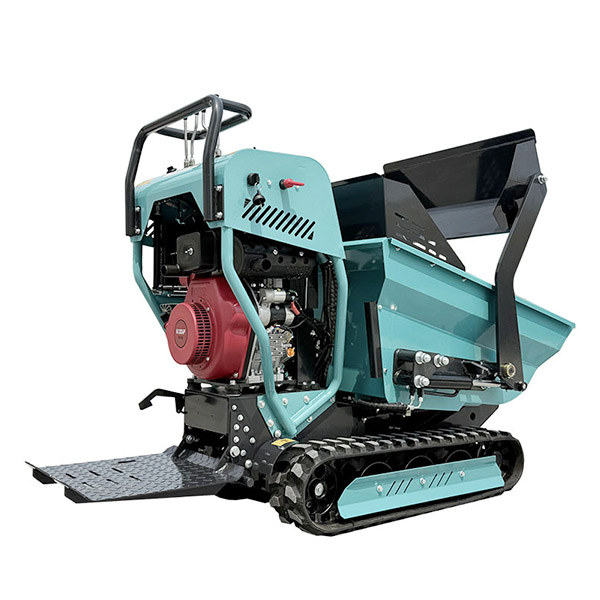
Understanding basic dimensions is only the first step. You must dive into the core specifications. These metrics determine how fast you can complete the job. We must align machine capabilities to site demands.
Finding the right payload balance requires careful thought. Narrow models typically haul between 500kg and 1000kg. You naturally want the highest payload possible. However, the machine's physical weight limits where it can safely operate. Suspended floors, wooden decking, and fragile paving stones have strict load-bearing limits. You must calculate the combined weight of the machine and a full load. Exceeding floor limits causes catastrophic structural failures. Always verify site engineering constraints before bringing heavy equipment indoors.
How you dispose of materials dictates your tipping mechanism. Manufacturers offer two primary configurations. Each serves a distinct operational purpose.
Standard Tip: This basic mechanism dumps materials directly onto the ground. Gravity handles the work. It remains perfectly sufficient for stockpiling soil, dumping gravel on driveways, or backfilling low trenches. It keeps the center of gravity extremely low during operation.
High-Tip (Scissor Lift): This complex configuration uses a hydraulic scissor lift. It raises the entire skip vertically before tipping. High-tip mechanisms are mandatory if you dump into standard skips. You also need them to load flatbed trucks or deposit material over retaining walls.
Your work environment dictates the power source. Environmental compliance requirements heavily influence this choice. Electric (battery-powered) machines are increasingly mandatory for indoor projects. They produce zero toxic emissions. They operate quietly, minimizing noise complaints in residential zones. Alternatively, combustion engines (gas or diesel) dominate outdoor sites. They offer longer continuous run times. Refueling takes minutes, whereas battery charging takes hours. You must evaluate ventilation and noise restrictions before deciding.
Efficiency relies on seamless equipment pairing. You must align your transport machinery with your digging machinery. We use simple math to guarantee a smooth workflow. Poor synchronization causes operators to stand around waiting.
The skip capacity should logically align with the bucket size of your chosen Mini Excavator. Achieving a full dumper load in three to five excavator scoops represents the perfect ratio. This prevents workflow bottlenecks. If the bucket needs ten scoops, you waste fuel and time. If it fills the skip in one massive scoop, you risk overloading and spillage. Always check cubic volume ratings for both machines before starting the job.
Height clearances matter just as much as volume. Ensure the excavator's maximum dump height easily clears the dumper's side walls. Operators should never struggle to lift the bucket over the skip. Forcing the bucket too close risks severe impact damage. Broken side panels reduce capacity and compromise safety. Allow at least twelve inches of vertical clearance between the bucket teeth and the skip edge.
Maneuvering two machines simultaneously in confined alleys requires strict choreography. Establish a clear traffic pattern. The excavator typically remains stationary near the spoil pile. The transport vehicle must reverse into the loading zone. Designate a specific turning area if the alley lacks width. Use spotters to guide reversing maneuvers. Clear communication prevents minor collisions. Keep the transport path entirely free of loose debris.
Using a massive bucket to load a tiny skip.
Failing to establish right-of-way rules in tight corridors.
Parking the transport vehicle on uneven ground during loading.
Ignoring overhead power lines during the loading arc.
Equipment operators face daily physical risks on narrow sites. Maintenance issues quickly halt production. We must address common pitfalls directly. Proactive management ensures your equipment investment remains highly profitable.
Rubber tracks demand consistent attention. We must acknowledge the reality of poor maintenance. Loose tracks will inevitably slip off in deep mud. Heavy debris pushes into the undercarriage, forcing the track off the idler wheel. Re-tracking a machine covered in wet clay causes severe downtime. Operators must check track tension every single morning. Clean the undercarriage thoroughly at the end of every shift. A clean machine rarely drops a track.
Tipping hazards increase dramatically on uneven ground. We strongly warn against overloading high-tip models on lateral slopes. Raising a heavy load shifts the center of gravity upward. If the machine sits on a sideways incline, elevating the skip introduces severe rollover risks. Always orient the machine facing straight up or down the slope before lifting the skip. Keep the load as low as possible during transit. Never drive across a steep slope fully loaded.
Operator fatigue leads directly to accidents. You must prioritize modern safety features. Look for machines featuring reliable dead-man switches. These instantly kill the engine if the operator releases the controls. Ride-on models require vibration-damped platforms. Constant shaking damages joints and drains operator energy. Intuitive hydraulic controls ensure smooth, predictable movements. Jerky levers cause spilled loads and property damage. Comfortable operators work faster and make fewer dangerous mistakes.
Finding the ideal material handling solution requires balancing three critical elements. You must perfectly align your access width, terrain capability, and payload requirements. Evaluating these factors upfront prevents costly project delays. We recommend a straightforward shortlisting logic to guide your final choice.
Step 1: Measure your absolute narrowest choke points to determine maximum machine width.
Step 2: Define your primary terrain to choose between wheeled and tracked drive types.
Step 3: Select your tipping mechanism based on how you dispose of materials (ground vs. skip).
Your next step involves practical verification. We strongly encourage buyers to request an on-site demonstration. Verify all warranty terms regarding track wear and hydraulic components. Consult your local equipment dealer to match specific machine dimensions against your most frequent job site profiles.
A: Ultra-compact models can measure as narrow as 28 inches (71 cm). Manufacturers design these specific dimensions to fit cleanly through standard residential doorways and narrow garden gates. Always verify the width includes the widest part of the tracks or tires.
A: Standard models cannot reach over skip walls. Only machines equipped with a "high-tip" or "hi-tip" scissor lift mechanism can safely clear standard skip heights. These models elevate the payload vertically before tipping it forward.
A: Electric models deliver equivalent torque for heavy loads. They offer massive indoor compliance advantages due to zero toxic emissions and low noise. However, battery life limits continuous runtime. Gas-powered models excel outdoors where fast refueling enables uninterrupted, all-day operation.
A: Tracked machines feature exceptionally low ground pressure, which generally protects soft surfaces. However, executing sharp, zero-turn pivot maneuvers will easily tear up established turf. Operators must execute wide, gradual turns to prevent ripping the grass.


