

Views: 0 Author: Site Editor Publish Time: 2026-07-01 Origin: Site
Selecting your next machine goes beyond a simple brochure comparison. It establishes a vital, long-term operational partnership. Machine downtime directly erodes your project margins. A broken machine means idle crews and lost revenue. Manufacturer marketing often highlights peak breakout forces and ideal conditions. However, real-world success hinges on localized dealer support and navigating specific jobsite constraints. You cannot rely on brand prestige alone.
This guide provides a skeptical, evidence-based framework for your next purchase. We help you systematically evaluate a mini excavator manufacturer and their regional dealer network. You will learn how to align machine specs with actual field environments. We will uncover what truly ensures maximum uptime and strong returns. Prepare to challenge common industry assumptions and protect your bottom line.
Jobsite Dictates Specs: Urban utility work and rural landscaping require fundamentally different tail swing, track, and emission profiles.
Dealer Support > Brand Name: A premium machine is a liability if the local dealer lacks a robust parts inventory and field service dispatch.
Hydraulic Versatility is Key: Evaluating auxiliary hydraulic flow rates prevents expensive attachment limitations down the road.
TCO Requires Verification: Look beyond the sticker price to evaluate warranty structures, financing, and historical resale values before finalizing a vendor.
Before examining brochures, analyze where you work. Different sites demand specific configurations. Physical space dictates your primary equipment size. Start by evaluating common access limits. Measure standard gate widths on your projects. Residential landscaping often requires passing through 36-inch gates. Note any indoor operational needs. Urban environments often impose strict space limitations.
You must determine the necessity of a Zero Tail Swing (ZTS) design. ZTS keeps the rear housing within the track width during rotation. It prevents accidental collisions against walls. Conversely, a conventional tail swing compact crawler excavator offers superior lifting stability. It works best when proximity to structures is less critical.
Next, look at emissions and compliance rules. You must assess local environmental regulations. Tier 4 Final and Stage V requirements heavily influence diesel engine choices. Regulators enforce these standards aggressively in city centers. You might need to add Diesel Exhaust Fluid (DEF) handling to your workflow. Consider electric or hybrid models for specific bids. They provide a massive advantage for indoor contracts. They also excel in heavily regulated urban zones.
Logistics and transport heavily influence daily operations. Consider these transport limitations:
Calculate the exact towing capacity limits of your current fleet vehicles.
Factor in standard trailer weight restrictions to avoid overloading axles.
Review Commercial Driver’s License (CDL) requirements in your specific region.
Account for bridge weight limits if you frequently traverse older municipal routes.
Standardizing equipment sizes helps you avoid unexpected transport fines. You do not want to buy a new commercial truck just to haul a slightly heavier machine.
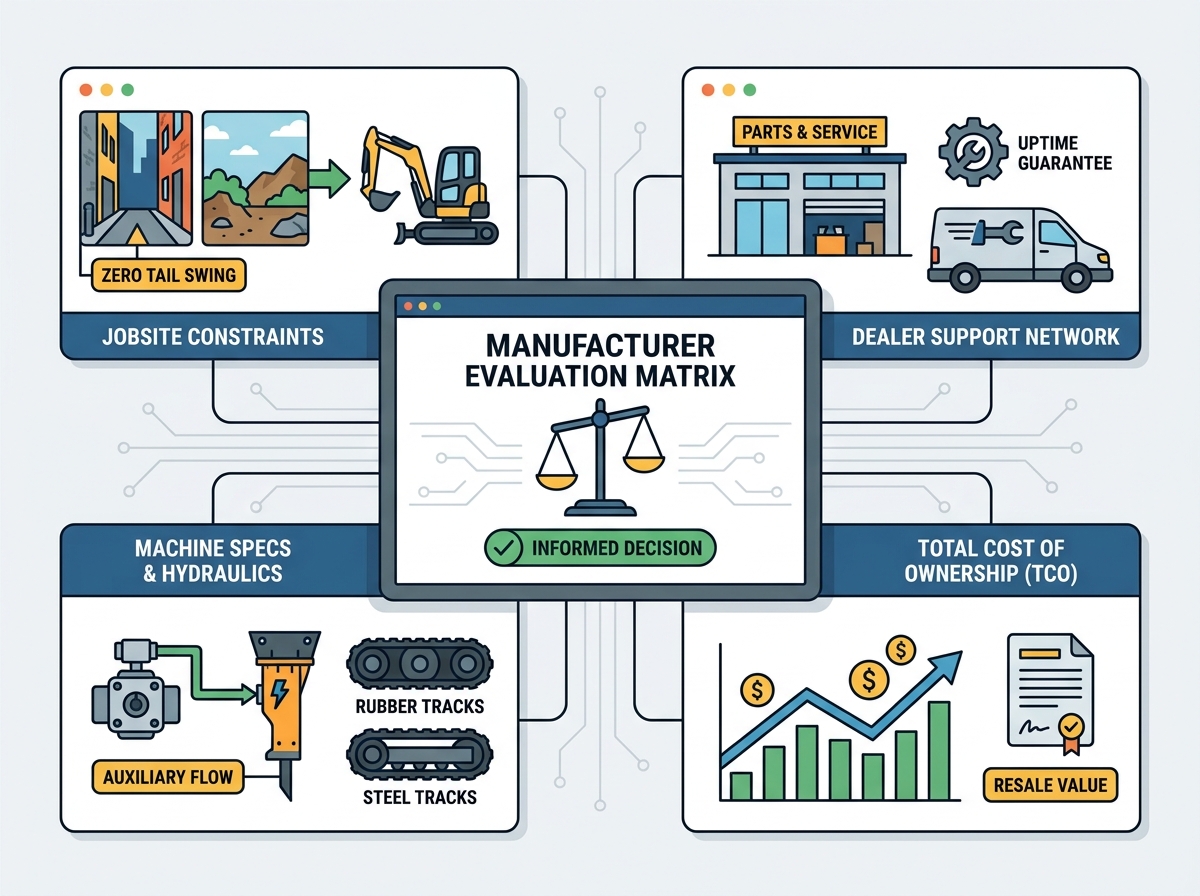
Manufacturers naturally want to sell machines. They frequently highlight peak performance numbers. You must translate these theoretical claims into jobsite realities.
First, investigate performance realities. Cross-reference marketed dig depths against your typical trenching needs. Compare advertised breakout forces against specific local soil types. Rocky terrain demands much higher force than soft clay. Look closely at industry-standard lifting capacity charts. You must evaluate lifting capacity over the side versus over the front. Over-the-front numbers always look impressive because the blade provides stabilization. Over-the-side numbers reveal real-world stability. You rarely dig and dump in a perfectly straight line.
Lifting Capability Analysis
Measurement Axis | Stability Factor | Best Use Case | Common Risk |
|---|---|---|---|
Over the Front | High (Supported by blade) | Straight trenching, pipe laying | Overestimating rotational capability |
Over the Side | Low (Track width dependent) | Loading trucks, tight maneuvering | Tipping if payload exceeds rating |
Undercarriage solutions determine ground mobility. Decide carefully between track materials. A rubber track excavator navigates finished concrete beautifully. It crosses asphalt smoothly and minimizes ground disturbance. Landscapers heavily favor this option. Alternatively, steel tracks provide aggressive traction. They dominate on rugged, uneven terrain. They resist cuts from sharp demolition debris.
Hydraulic system architecture drives attachment performance. Analyze the auxiliary hydraulic flow rates carefully. Ensure the hydraulic mini digger can seamlessly power high-demand attachments. Flail mowers, augers, and hydraulic breakers require steady, robust flow. Undersized hydraulics cause frequent overheating. They lead to sudden pressure drops under load. This limits your machine's versatility and damages internal seals.
A strong brand cannot fix a weak local dealer. Post-purchase support dictates your uptime. Treat the dealer interview just like a job interview.
Investigate parts availability and Service Level Agreements (SLAs). Interrogate the local dealer’s fill rate for common wear parts. You need immediate access to filters, hoses, and bucket teeth. Ask about guaranteed turnaround times for critical component replacements. Some dealers guarantee 24-hour parts delivery. Delays here directly stall your job and frustrate your crew.
Assess their field service capabilities thoroughly. Find out the size of the local mobile mechanic fleet. Evaluate their typical dispatch responsiveness during peak construction season. Verify warranty work logistics. Some dealers require hauling the machine to their shop. Others treat on-site repairs as standard procedure. On-site service saves you immense transport time and logistical hassle.
Technology and telematics offer predictive advantages. Evaluate the fleet management software provided by the manufacturer. Look for transparent reporting tools. Good software tracks idle times accurately. It monitors fuel consumption closely. It sends proactive predictive maintenance alerts. These alerts prevent minor wear from becoming a catastrophic failure.
Buying heavy machinery carries inherent financial risk. Smart contractors look beyond the initial sticker price. You must evaluate long-term financial exposures and procurement protections.
Analyze warranty structures carefully. Break down the actual differences between standard and extended warranties. Look actively for hidden exclusions. Many policies omit undercarriage wear entirely. Some exclude expensive hydraulic seals or cab glass. Read the fine print before signing anything.
Investigate resale and residual value. Research the secondary market carefully. Check historical depreciation data for your specific small earthmoving machine brand. Tier-1 manufacturers typically retain higher residual values. A higher resale price later easily offsets a higher initial purchase price today. Strong resale demand indicates a highly reliable product line.
Compare financing and procurement flexibility. Review factory-backed financing rates against traditional bank loans. Explore lease-to-own programs for short-term risk reduction. Look for seasonal payment structures. Many manufacturers design these programs specifically for cyclical construction cash flows. Flexible payments protect your operational liquidity during slow winter months. You can often skip payments when revenue drops.
You now have a solid evaluation framework. It is time to execute the procurement process. A structured approach removes emotional bias from buying equipment.
Deploy the "Rent-to-Test" strategy before buying. Mandate a short-term rental of the exact model. Conduct a real jobsite demo. Do not test it in an empty, flat parking lot. Put it in the dirt under heavy load. Follow these steps during the test:
Assign your most experienced operator to run the machine.
Test specific attachments you plan to use daily.
Evaluate cab ergonomics, seat comfort, and blind spots.
Solicit unvarnished feedback regarding control responsiveness.
Operator fatigue directly impacts daily productivity. If your operators hate the cab, production will drop.
Prioritize aggressive reference checking. Bypass polished manufacturer case studies. Speak directly with local contractors. Find peers operating the exact same brand in your specific region. Verify actual uptime statistics. Confirm local dealer reliability. Real contractors gladly share honest pain points and mechanical warnings.
Evaluation Weighting Matrix
Decision Criteria | Weight Priority | Core Focus |
|---|---|---|
Dealer Support | 40% | Parts availability, field service speed |
Spec Alignment | 30% | Hydraulic flow, digging depth, footprint |
Financial Flexibility | 20% | Warranty coverage, residual value, rates |
Operator Preference | 10% | Cab comfort, visibility, control feedback |
Finalize your choice using this decision matrix. This objective formula prevents expensive mistakes driven by flashy marketing.
Choosing the right equipment requires a balanced approach. You must align mechanical specs with hard logistical realities. Aftermarket reliability matters just as much as lifting capacity. Never sacrifice local support infrastructure for brand prestige alone.
Focus on these specific action-oriented steps next:
Measure your most common jobsite access points and gate widths today.
Request precise auxiliary hydraulic flow charts from your top three brand choices.
Interview local dealer service managers specifically about standard parts availability.
Schedule a hands-on field demo for your primary operators.
Take control of the evaluation process. Contact trusted local dealers this week to begin your hands-on trials.
A: A zero tail swing design keeps the rear housing strictly within the tracks during rotation. It excels in tight spaces and prevents accidental wall collisions. A conventional tail swing extends beyond the tracks. It offers superior lifting capacity and heavy load stability but requires more open operating space.
A: Choose rubber tracks for finished surfaces like concrete, asphalt, or manicured lawns. They minimize ground damage and operating noise. Opt for steel tracks when working on rugged, rocky, or muddy terrain. Steel provides aggressive traction and much better durability against sharp demolition debris.
A: They typically range from 1 to 10 metric tons. Machines under 3 to 4 tons can usually be towed using a heavy-duty pickup and standard trailer. Larger classes require commercial transport vehicles. They may also necessitate a Commercial Driver’s License (CDL) depending on specific local regulations.
A: It is absolutely critical. Auxiliary flow determines what attachments you can run efficiently. High-demand tools like mulchers or large breakers require robust flow rates. Inadequate flow leads to sluggish performance, frequent overheating, and premature hydraulic system failure. Always verify flow rates before purchasing.
A: Renting is ideal for short-term projects or testing a specific model. It avoids maintenance costs and long-term storage issues. Buying makes financial sense if you utilize the machine consistently year-round. Consistent utilization quickly offsets the initial purchase price compared to paying continuous weekly rental fees.


