

Views: 0 Author: Site Editor Publish Time: 2026-07-02 Origin: Site
Operating in confined spaces—like residential backyards, interior demolitions, or narrow agricultural aisles—eliminates the margin for equipment error. One wrong turn can easily damage surrounding property or delay your project timelines significantly. Choosing the right machine is only half the battle. Partnering with a reliable skid steer loader supplier ultimately dictates your overall uptime, maintenance schedules, and operational scalability. A poor dealer choice often leaves you stranded when critical components fail during a tight deadline.
This guide breaks down the top supplier networks based on their compact equipment availability, reliable after-sales support, robust attachment ecosystems, and transparent pricing structures. You will discover exactly how to evaluate local dealers and match specific machine profiles to your most demanding, space-restricted job sites.
Supplier network density (local parts and mechanics) is just as critical as machine specifications when evaluating a purchase or lease.
The shift toward a compact skid loader requires verifying that the supplier offers specialized, scaled-down attachments.
A versatile track loader outperforms wheeled variants in soft, confined terrain, but increases total cost of ownership (TCO) via undercarriage maintenance.
Shortlisting requires requesting on-site demos to test actual maneuverability in your specific tight workspace.
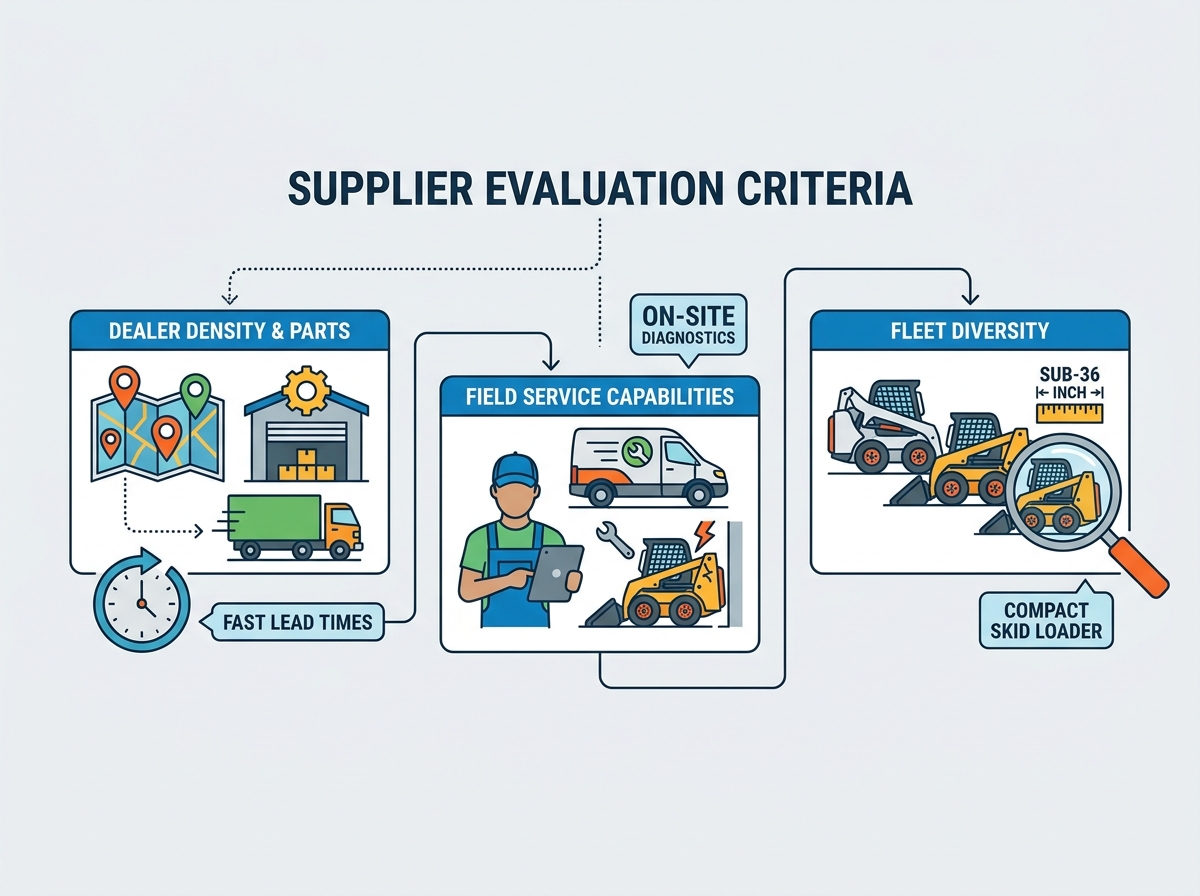
You must rigorously assess promised lead times for essential wear parts. Filters, hydraulic hoses, and major powertrain components should be available locally. A strong local footprint prevents minor breakdowns from ruining your weekly schedule.
Avoid suppliers relying entirely on centralized distribution centers. These setups require cross-country shipping for emergency repairs. When a machine breaks down in a narrow alleyway, you cannot afford a three-day wait for a replacement hydraulic valve. Always ask a prospective dealer about their on-hand inventory levels for your specific model. Prioritize dealers who guarantee next-day parts availability within your working radius.
You need to evaluate mobile mechanic dispatches thoroughly. Machines often get stuck in hard-to-access workspaces. Towing a dead unit out of a residential backyard is sometimes physically impossible. The dealer must provide robust field service capabilities.
Field technicians should carry advanced diagnostic laptops. They need the tools to clear electronic fault codes directly on your job site. We recommend requesting a copy of their standard service level agreement. Verify their average dispatch response time. A top-tier network will prioritize downed equipment to keep your crews moving.
Ensure your chosen dealer stocks a true compact skid loader range. Many dealers focus heavily on standard heavy-duty models. You need access to sub-36-inch widths and stand-on units for restricted areas.
Diverse fleets prove a supplier understands niche applications. They should offer machines capable of navigating through standard pedestrian gates. Ask to see their dedicated compact inventory. If they try to upsell you on a wider, heavier machine, they probably lack the specialized equipment your confined job sites demand.
(Note: Evaluation assumes North American/Global tier-1 and tier-2 networks; localized dealers should be measured against these OEM standards.)
These networks rank highly due to their unmatched dealer footprint. You will find localized parts availability almost everywhere. They dominate the market presence.
They act as pioneers of the compact frame. You gain access to a massive inventory of proprietary micro-attachments. This makes them highly effective in tight spaces. You can tackle diverse tasks without switching machines. However, you must consider the premium pricing on OEM parts. Always verify third-party attachment compatibility before committing to their ecosystem.
Heavy-duty crossovers pack high-flow hydraulics into smaller frames. They also provide top-tier warranty structures. You get immense power in a reduced footprint.
They offer excellent cab visibility. Advanced joystick controls allow precise movements in zero-margin environments. You can navigate delicate residential hardscapes safely. Consider their operating weight, though. They tend to be heavier. You must evaluate your job site ground pressure limitations to avoid damaging finished surfaces.
These specialists dominate the landscaping and tight-yard farming sectors. They provide reliable diesel and gas powertrain options. They understand agricultural demands perfectly.
They boast exceptionally balanced roll-over capacities in their narrower models. This stability is crucial when lifting heavy loads on uneven, confined terrain. Keep in mind their hydraulic flow limitations. Base models might not support high-demand attachments like heavy-duty mulchers or cold planers. Always match your attachment needs to their spec sheets.
These brands specialize in mini, walk-behind, and stand-on loaders. They excel where traditional sit-down models fail entirely. Their engineering focuses solely on spatial restriction.
They are ideal for interior demolition and standard gate-access. Sub-36-inch profiles fit almost anywhere. A gasoline mini loader from these suppliers often bypasses strict diesel emissions requirements. You can use them for indoor or semi-indoor applications safely. Remember their lower lift capacities. You should strictly reserve them for niche, confined-space applications rather than heavy earthmoving.
Challengers rank well due to innovative designs. The single-arm (Powerboom) design prioritizes operator safety and side-entry. This breaks the mold of traditional front-entry loaders.
The side-door entry is a massive advantage in tight spaces. Operators can exit the machine safely even when parked nose-first against a blank wall. You never get trapped inside the cab. Consider their dealer network density, however. They may have a smaller footprint in rural regions. Always verify your proximity to a certified mechanic.
Supplier Categories Matrix
Supplier Category | Primary Strength | Ideal Tight-Space Application | Primary Limitation |
|---|---|---|---|
Legacy Network | Massive attachment ecosystem | General confined contracting | Premium OEM part pricing |
Heavy-Duty Crossover | High-flow hydraulics | Heavy demolition in tight lots | Higher ground pressure |
Ag & Landscape | Roll-over stability | Uneven yard grading | Base model hydraulic flow |
Ultra-Compact Innovator | Sub-36-inch profiles | Interior renovations | Limited lifting capacity |
Value Challenger | Side-door operator exit | Alleyway & trench work | Rural network density |
Wheeled machines perform better on hard surfaces. You will typically encounter concrete and asphalt in urban tight spaces. Tires handle these abrasive surfaces effectively without excessive wear.
Wheels allow for aggressive zero-radius pivoting. You can spin the machine completely around within its own footprint. This maneuverability is essential in narrow driveways. However, aggressive turning causes "tire scrub." This action easily damages sensitive surfaces like stamped concrete or fresh asphalt. You must train operators to perform three-point turns whenever possible to minimize surface destruction.
A versatile track loader distributes operating weight efficiently across a larger surface area. This makes it an effective all-terrain machine. You can handle mud or finished turf without leaving deep, destructive ruts.
Tracks provide superior pushing power in short distances. They grip the earth aggressively. You can easily push heavy debris out of an alleyway or grade a slippery incline. Implementation reality sets in during breakdowns, however. If a machine de-tracks inside a highly confined space, resetting the heavy rubber track is notoriously difficult. Field mechanics struggle to position jacks and pry bars without adequate side clearance.
A machine’s value in a tight space multiplies rapidly when it functions as a multi-attachment loader. One power unit can perform ten different jobs. You must evaluate suppliers based on their hydraulic quick-attach mechanisms.
Modern quick-couplers allow operators to swap tools without leaving the cab. This feature saves immense time during complex landscaping projects. Test the locking pins during your evaluation. They should engage smoothly. Dirt and debris often jam poorly designed couplers, killing your productivity on site.
You need specific tools to maximize productivity in restricted zones. Standard buckets often prove too clumsy for detailed residential work. Consider adding these essential tools to your inventory:
Pallet forks: These are absolutely critical for navigating narrow warehouse aisles or moving sod pallets through residential gates.
Augers: Perfect for drilling fence posts near property lines where larger excavators cannot swing safely.
Micro-trenchers: Essential for laying residential fiber-optic cables or irrigation lines without destroying the surrounding lawn.
You must rigorously match attachments to your machine's capabilities. Warning: Do not purchase high-flow attachments for standard-flow compact machines. The implement will stall under load.
Verify hydraulic compatibility directly with the supplier's engineering specs. Pushing a standard-flow pump to run a high-demand forestry mulcher overheats the hydraulic fluid rapidly. This mistake damages internal seals and voids warranties. Always consult your dealer to map out a safe, compatible attachment package before signing any purchase agreement.
You must evaluate the supplier's preventative maintenance contracts carefully. Uptime dictates your project success. Choose dealers who offer comprehensive service agreements that align with your operational hours.
Review their scheduled maintenance intervals. Determine whether they perform routine fluid changes on your site or require shop visits. On-site preventative maintenance keeps your crew working and eliminates transportation downtime. Factor these service logistics into your final decision. A supportive dealer acts as a true partner in maximizing your daily output.
Never buy equipment off a glossy spec sheet for tight spaces. Numbers on paper rarely translate perfectly to real-world obstacles. You must demand that the supplier brings the unit to your typical job site.
Run through a strict checklist during this demo. Check operator visibility to the bucket edge while maneuvering around walls. Verify your tail-swing clearance against existing structures. Finally, assess the ease of routine maintenance access. Can you open the rear engine door when parked inside an alley? If you cannot access the dipstick or air filter easily, routine maintenance will inevitably suffer.
Purchasing equipment for restricted workspaces is a constant exercise in compromise between footprint and power. You cannot fit heavy-duty lifting capacity into a micro-sized frame. The right skid steer loader supplier will transparently guide you through this trade-off rather than simply upselling a larger machine you cannot maneuver.
Audit your local suppliers immediately. Map out the exact driving distance to their nearest service center. Request their complete compact equipment inventory lists to verify diversity. Finally, schedule a physical site demo to witness how their machines handle your most challenging job sites.
A: Most walk-behind or mini-loaders require a minimum width of 36 to 48 inches to pass through standard residential gates. However, operators frequently overlook vertical dimensions. Overhead clearance for the ROPS (Roll-Over Protective Structure) is equally critical, especially when working indoors, under low tree canopies, or in subterranean parking garages. Always measure your lowest pinch point.
A: Your decision should frame around project frequency. Occasional tight-access jobs strongly favor renting. This approach helps you avoid niche equipment depreciation and storage hassles. Conversely, dedicated residential landscapers or hardscape contractors who work in confined yards daily benefit significantly from purchasing. Owning guarantees immediate machine availability and allows for customized attachment ecosystems.
A: You must clarify their engineering limitations. Gas models excel in short bursts and are perfect for indoor or residential areas due to simpler emission profiles. However, they lack the sustained low-end torque found in diesel engines. While they can dig and grade effectively, they are not designed for continuous, heavy earthmoving or breaking solid bedrock all day.


