

Views: 0 Author: Site Editor Publish Time: 2026-05-12 Origin: Site
Equipment selection acts as a primary driver of project profitability. Choosing the wrong transport vehicle quickly leads to idle excavator time, severe compliance fines, or terrain-induced breakdowns. Modern construction requires matching specific chassis configurations, payload capacities, and dumping mechanisms directly to distinct site realities. You cannot simply deploy a highway hauler into deep mud and expect operational efficiency.
This guide breaks down the core categories of transport vehicles. We provide a practical framework for evaluating which configuration aligns best with your daily operational demands. Read on to discover how you can align your fleet capabilities with specific job site restrictions, terrain challenges, and rigid compliance mandates.
Site-Specific Matching: Articulated trucks dominate off-road, muddy terrain, while standard multi-axle trucks maximize legal payloads on highway routes.
Compact Agility: Tight-access sites increasingly rely on specialized equipment like the mini dumper truck to reduce manual labor and navigate confined spaces safely.
Compliance First: Procurement decisions must begin with local bridge weight formulas and commercial driver's license (CDL) requirements.
Total ROI: Evaluating a dump truck requires looking beyond initial price to cycle times, payload-to-weight ratios, and EPA emission compliance.
Construction sites demand varied transport solutions. Contractors must match the vehicle's frame and drive system to the specific ground conditions they face daily.
Standard rigid Dump Trucks feature a chassis where the cab and the dump body sit on a single fixed frame. They offer excellent maneuverability on paved surfaces. You will find them highly successful on short-haul urban infrastructure projects. Drivers can navigate standard city intersections easily. However, rigid frames face severe limitations off-road. They lack structural flexibility. This rigidity causes poor traction in deep mud or heavily unpaved grading sites.
Articulated models solve the off-road traction problem. They feature a distinct hinge between the cab and the dump box. This hinge allows the vehicle to twist and bend. All-wheel drive capabilities come standard on most ADTs. They dominate severe off-road conditions, mining operations, and early-phase earthmoving projects. The pivot point keeps all tires on the ground over uneven terrain. Their main limitation is a higher initial cost. Furthermore, manufacturers do not design them for long-distance highway hauling.
Highway hauling requires maximizing legal payloads without violating federal weight limits. Transfer and superdump configurations solve this issue. They distribute weight across multiple trailing axles. This design allows operators to haul heavy loads while meeting strict federal bridge laws. The success criteria revolve entirely around highway efficiency. However, limitations exist. These vehicles require highly experienced operators. Trailing axles complicate reversing maneuvers. They also demand extensive physical space for offloading.
Truck Category | Ideal Terrain | Primary Advantage | Major Limitation |
|---|---|---|---|
Standard (Rigid) | Paved roads, urban areas | Tight turning radius | Poor off-road traction |
Articulated (ADT) | Mud, unpaved grading | All-wheel drive, flexibility | Poor highway efficiency |
Transfer / Superdump | Highways | Maximum legal payload | Needs large offload space |
Urban sprawl forces contractors into increasingly cramped workspaces. Full-sized heavy equipment simply cannot enter many modern job sites.
Contractors face growing business challenges in residential construction, landscaping, and urban utility work. Standard commercial vehicles cannot physically navigate narrow residential property lines. Bringing heavy machinery onto finished driveways often causes expensive surface damage. To overcome these obstacles, fleets increasingly adopt compact hauling solutions.
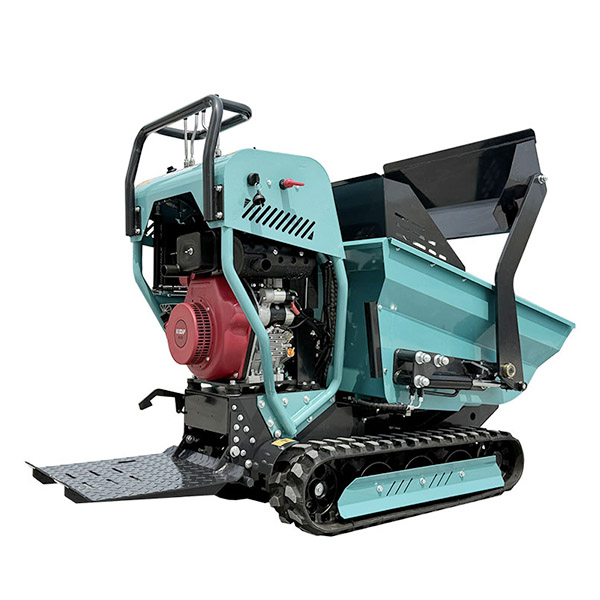
A compact mini dumper truck serves as a highly mobile tracked or wheeled buggy. Engineers design them specifically to move aggregates or spoil through narrow gates. They excel in heavily congested work zones. The labor impact is massive. They entirely replace manual wheelbarrow labor. A single operator can move tons of material daily without extreme physical exhaustion. This reduces cycle times and significantly minimizes worker fatigue.
Modern compact equipment now incorporates advanced mechanical features. We look to the EPA Diesel Hydraulic Self Loading Crawler Mini Dumper as a prime example of high-efficiency, multi-function equipment. When evaluating advanced compact models, you should examine several key features:
Self-loading shovel capabilities: Eliminates the need for a separate mini excavator to load the hopper.
Hydraulic tipping mechanics: Ensures smooth, controlled dumping of heavy wet materials.
Ground-pressure reduction: Crawler tracks distribute machine weight, protecting sensitive turf and soft soils.
Emission compliance: Tier-4 Final/EPA diesel engines allow safe use in heavily regulated urban zones.
Fleet managers need a structured approach to equipment evaluation. Selecting the correct model requires analyzing terrain, payload rules, and environmental regulations.
Assess Terrain and Ground Conditions:
You must evaluate whether the vehicle will primarily travel on paved highways or unimproved job sites. Paved routes dictate the choice of rigid frames for maximum speed and control. Unimproved, muddy terrain demands articulated frames or crawler tracks. Soft ground requires specialized tires or continuous tracks to prevent the vehicle from sinking.
Calculate Payload and Volume Requirements:
Always compare the Gross Vehicle Weight Rating (GVWR) against your typical material density. Wet clay weighs drastically more per cubic yard than dry topsoil. This density variance directly impacts your necessary box capacity. It also determines the specific hydraulic lift cylinder specifications you need. Buying a box that is too large for dense materials tempts operators to overload the vehicle.
Verify Regulatory & Safety Compliance (DOT/EPA):
Federal and state weight restrictions rigidly define vehicle categories. You must assess the Class 1-8 commercial vehicle mandates in your region. Drop axles often become necessary to meet state bridge weight formulas. Furthermore, environmental mandates strongly influence engine selection. You must secure EPA-compliant diesel engines to operate legally in major metropolitan areas.
Acquiring construction equipment involves distinct financial strategies and operational risk management. You must protect your fleet from unnecessary downtime and poor asset selection.
Procurement strategies vary based on project duration. Short-term project leasing makes sense when you need specialized equipment for just a few weeks. It keeps maintenance liabilities off your balance sheet. Conversely, long-term asset acquisition works best for core daily operations. Buying new provides warranty coverage and reliability. Buying used reduces initial capital output but increases your immediate maintenance exposure.
When searching for specialized inventory, evaluating sellers critically becomes paramount. If you are actively looking for a mini dumper truck for sale, watch for specific industry red flags. Avoid sellers who cannot provide clear warranty documentation. Missing EPA certification documents present a massive legal liability. Inadequate aftermarket parts support will inevitably strand your equipment during critical project phases.
Maintenance accessibility directly impacts project uptime. When reviewing a model, evaluate the physical accessibility of its grease points. Hard-to-reach grease fittings usually get ignored by busy operators. Assess the overall hydraulic system complexity. Highly complex systems require specialized dealer technicians for repairs. Additionally, review the diesel particulate filter (DPF) maintenance requirements. EPA-compliant engines require periodic DPF regeneration, which you must factor into daily operational schedules.
Moving from evaluation to purchase requires methodical shortlisting. Taking a data-driven approach protects your investment.
Audit Your Fleet: Identify the specific payload bottlenecks holding your projects back. Pinpoint exact site-access limitations you consistently encounter in upcoming project blueprints.
Consult Local Regulations: Verify DOT weight classes for your heaviest routes. Cross-reference emission restrictions in your primary operating regions to avoid deploying non-compliant engines.
Request Demonstrations: Prioritize equipment dealers that allow on-site testing. Test the machinery under actual load conditions. Testing matters immensely for specialized hydraulic and crawler models, as they behave differently under maximum payload.
There is no universal transport vehicle for every construction site. A highway superdump will fail miserably in a muddy trench. Conversely, an articulated hauler wastes time and fuel on paved city streets. Profitability relies entirely on tightly aligning your equipment specifications with the unique demands of your daily job sites.
Evaluate payload limits, assess ground pressure needs, and review regulatory restrictions carefully. From heavy-duty articulated haulers to agile crawler mini dumpers, matching the asset to the environment ensures maximum efficiency. We encourage you to embrace a fully data-driven procurement approach. Track your cycle times, monitor payload capacities, and verify strict environmental compliance before signing any purchase order.
A: A standard dump truck uses a rigid chassis where the cab and dump box share one continuous frame. It excels on paved highways. An articulated dump truck features a hinge point between the cab and the dump box. This hinge provides extreme flexibility, allowing it to navigate severe off-road and muddy terrain efficiently.
A: Heavy-duty commercial trucks typically fall into DOT Class 7 or Class 8. Class 7 includes vehicles with a GVWR from 26,001 to 33,000 pounds. Class 8 includes vehicles with a GVWR over 33,000 pounds. Operating these heavy classes usually requires specialized commercial driver's licenses (CDL).
A: Contractors should invest in a mini dumper when job sites feature access widths too narrow for standard equipment. They prove highly valuable when manual labor costs and worker fatigue from wheelbarrow use drain project budgets. They offer excellent ROI by increasing material movement speeds in tight residential or urban spaces.
A: Yes, reputable manufacturers build crawler mini dumpers using Tier-4 Final or equivalent EPA-compliant diesel engines. These modern engines meet strict environmental mandates. However, buyers must explicitly verify EPA certification documents before purchase to ensure legal operation in regulated urban zones.


