

Views: 0 Author: Site Editor Publish Time: 2026-07-04 Origin: Site
Selecting the wrong compaction equipment leads to failed density tests. You risk severe surface defects and costly project rework. The stakes are simply too high for guesswork. Fleet managers and contractors face a common conflict daily. They weigh the superior traction and site-prep versatility of a single drum. Then, they compare it against the finishing speed of a double drum. A double drum offers unmatched dual-compaction power. This guide strips away confusing marketing noise. We provide a strictly operational framework for your business. You will learn how to choose between single and double drum configurations. We examine specific material requirements and job site conditions. Finally, we show you how to vet the right supplier for your fleet. You need a reliable partner to ensure maximum uptime.
Material Dictates the Machine: Single drum rollers dominate soil and sub-base prep due to superior traction; double drum rollers are mandatory for high-efficiency asphalt finishing.
Production vs. Versatility: Double drums compact faster by covering the area twice per pass, but lack the maneuverability and gradeability of single drums on uneven terrain.
Supplier Evaluation Matters: Choosing a reputable double drum roller manufacturer impacts Total Cost of Ownership (TCO) through parts availability, telematics, and warranty terms more than baseline specs.
Hidden Costs: Double drums require stricter maintenance protocols, particularly regarding water spray systems and dual-vibration isolation mounts.
The single drum design provides an industry-standard foundation. It features a heavy steel drum upfront. Pneumatic tires support the rear section. This unique hybrid design maximizes forward momentum. The tires grip loose materials efficiently. The front drum crushes air voids out of the ground.
You primarily use this machine for foundational earthwork. It excels at dirt and gravel compaction. Geotechnical engineers demand strict density requirements before paving begins. You need this machine to establish a solid sub-base. It handles cohesive soils beautifully. Operators frequently deploy it in deep trench applications.
This configuration offers distinct site benefits. You gain high traction on challenging terrain. The rear tires push the machine up steep trenches. They navigate uneven ground effortlessly.
Deep Penetration: The heavy concentrated weight rests entirely on the front drum. This drives compacting force deep into the soil.
Superior Gradeability: The pneumatic tires prevent the machine from slipping backwards. You can safely operate on steeper inclines.
Site Mobility: The equipment navigates unimproved job sites easily. It turns sharply around tight corners.
This machine fails entirely at asphalt finishing. The pneumatic tires will immediately scar the hot mix. The rubber treads leave deep, unfixable ruts. Furthermore, it covers less ground per pass. Dual-drum setups offer twice the surface contact. Single drums strictly belong in the dirt phase.
Evaluating an asphalt soil roller always starts at the base layer. The base layer dictates structural integrity. Single drums excel at preparing this foundation. You must assess the soil type first. Then, you match the drum weight to the required lift thickness. This ensures a stable platform for future paving.
Always check soil moisture content before rolling.
Overlap each pass by at least six inches.
Maintain a consistent speed to ensure uniform density.
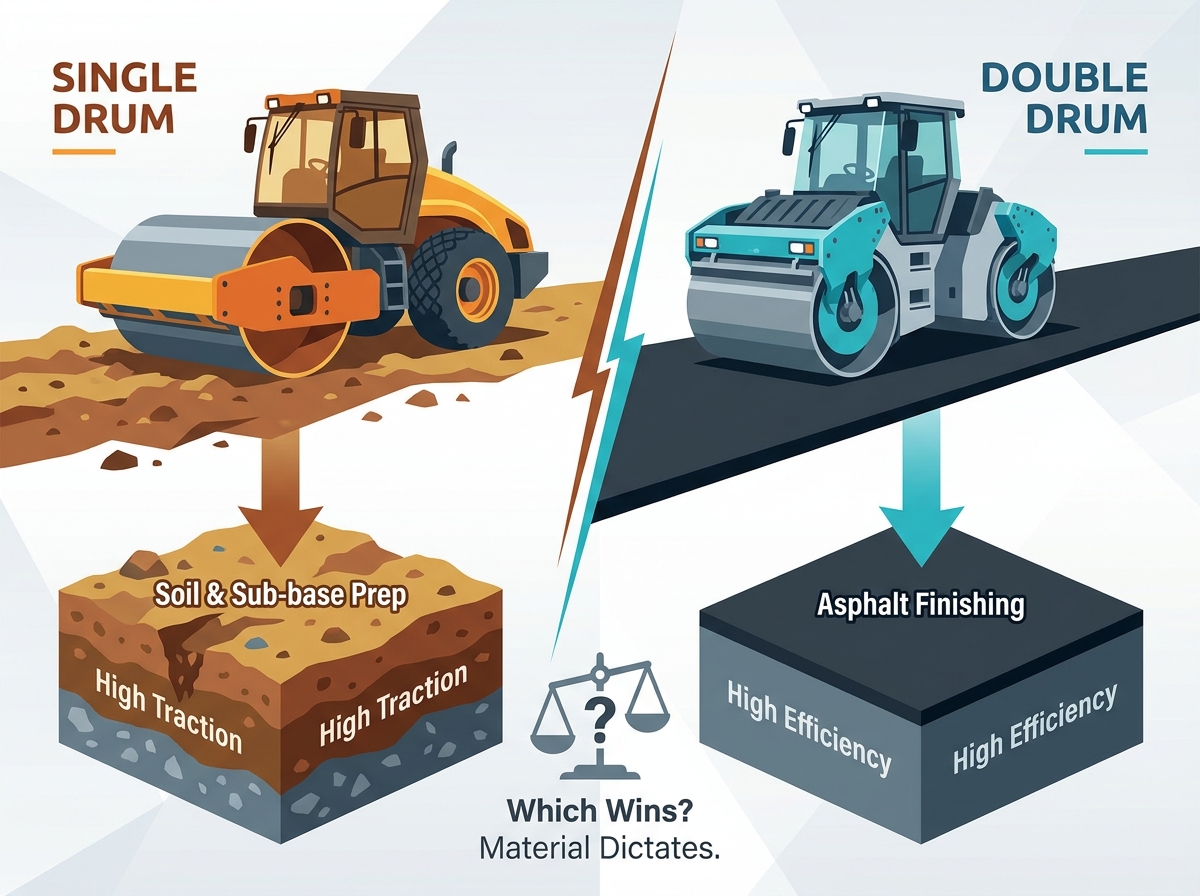
This machine represents the ultimate paving solution. It completely replaces rear tires. A second steel drum takes their place. This allows front and rear compaction simultaneously. You effectively double your surface contact. The machine glides over freshly laid materials.
You deploy this equipment for asphalt paving. It dominates highway construction projects. Large-scale flat surface finishing requires this exact machine. Parking lots and airport runways rely on its precision. It seals the asphalt surface to prevent water intrusion.
The dual-drum design transforms paving efficiency. You hit density targets much faster. The machine smooths surfaces in both forward and reverse. It leaves absolutely no tire marks behind.
Unmatched Efficiency: You compact the mat twice in a single pass. This drastically reduces total operating time.
Raw Power: It functions as a highly effective vibratory road compactor. You halve the passes needed to hit density specs.
Flawless Finish Quality: Integrated water systems spray the drums constantly. This prevents hot asphalt adherence. You guarantee a perfectly smooth mat every time.
This machine struggles on loose dirt. It lacks the grip provided by rubber tires. Steep grades pose a serious safety risk. The smooth drums easily slide on inclines. Operators also face a higher risk of error. Improper use leads to severe over-compaction. You might accidentally displace material if you vibrate a cold mat.
Vibrating the drums while the machine is stationary.
Ignoring clogged water spray nozzles.
Rolling the asphalt after it cools below critical temperatures.
Hardware specifications are largely commoditized today. Operating weights look identical across brochures. Drum widths barely vary between brands. The real differentiator is operational uptime. You need robust aftermarket support. A cheap machine becomes wildly expensive during unexpected downtime.
Modern paving requires extreme precision. Does your chosen double drum roller manufacturer offer integrated pass-mapping? They should provide stiffness-measuring sensors. These tools actively prevent over-compaction. Over-compaction crushes aggregate and ruins the road. IC technology displays real-time data on the dashboard. Operators know exactly when to stop rolling.
You must avoid discount manufacturers entirely. They rarely stock essential replacement parts. Assess the guaranteed turnaround time carefully. You will eventually need proprietary components. Vibration motors fail under heavy use. Water pumps clog and break down. Ensure the supplier guarantees overnight parts delivery.
Operator fatigue directly impacts mat quality. A tired operator makes costly mistakes. Look for machines offering 360-degree visibility. Sliding seats allow operators to view the drum edges. Intuitive vibration controls keep their eyes on the road. Comfort directly translates into superior pavement finishes.
Always verify strict emissions compliance. Tier 4 Final engines are legally required in many regions. Read the fine print carefully. Separate the powertrain warranty from the hydraulic warranty. Hydraulic systems endure massive stress during vibration. You need comprehensive coverage for hydrostatic drives.
Evaluation Category | Standard Manufacturer | Premium Manufacturer |
|---|---|---|
Intelligent Compaction | Basic GPS tracking only | Real-time stiffness and pass-mapping |
Parts Delivery | 3-5 business days | 24-hour guaranteed delivery |
Operator Ergonomics | Fixed seat, limited view | Sliding seat, 360-degree visibility |
Hydraulic Warranty | 1 year / 1000 hours | 3 years / 3000 hours |
Building a profitable fleet requires careful planning. Double drums carry significantly higher upfront costs. You are essentially buying two compaction systems. They require maintaining two sets of drum scrapers. You must clean double the spray nozzles. You also service twice as many vibratory bearings. These maintenance tasks drain resources quickly.
Analyze your current project pipeline thoroughly. You must determine your true equipment needs. Does your schedule justify buying a specialized ride-on road roller? If you only pave occasionally, buying makes no sense. Renting is much safer for mixed-use portfolios. You avoid letting expensive assets sit idle in the yard.
Fleet uniformity saves immense time and money. Keep your construction compaction equipment strictly standardized. Limit your fleet to one or two reliable brands. This strategy drastically reduces technician training time. Mechanics learn the specific hydraulic layouts faster. It also simplifies your parts inventory. You only stock filters and belts for one engine type.
Your equipment must match your paving speed. Calculate the required tons-per-hour of your paving train. The paver lays material continuously. The roller must keep pace perfectly. If the roller falls behind, it becomes a bottleneck. The asphalt cools before achieving proper density. If you face this issue, you must act. This bottleneck completely justifies a larger dual-drum investment.
Calculate daily asphalt tonnage requirements.
Match roller width to the standard paver screed width.
Ensure the water tank capacity lasts a full shift.
There is no universal winner here. Single drums clearly win on earthwork. They offer unbeatable traction and versatility. Double drums completely dominate asphalt production. They provide superior finishing speed and quality.
Take immediate action on your fleet strategy. First, audit your upcoming 12-to-24-month project pipeline. Categorize jobs by material volume, separating soil from asphalt. Second, calculate your required daily tonnage rates. Finally, initiate demos with top-tier manufacturers. You must test operator visibility firsthand. Let your crew evaluate the interface usability before signing any contracts.
A: Generally, no. The rear tires will leave ruts in the hot asphalt. The rubber aggressively tears the fragile mat. However, crews occasionally use them for base-course patching. In these rare instances, aesthetic finish is irrelevant to the final product.
A: Yes. Most modern double drum rollers feature selectable vibration. Operators can easily toggle vibration on the front drum. They can switch to the rear drum or activate both simultaneously. They adjust this based on the required compaction force and material thickness.
A: Drum width directly determines pass efficiency. Wider drums cover more ground quickly. However, increased width severely limits site maneuverability. Buyers must balance the drum width against job site constraints. You must also consider the narrowest transport trailers you regularly use.
A: Clogged water spray nozzles represent the most frequent failure. The machine requires consistent, even water flow. Without it, hot asphalt instantly sticks to the steel drums. This rapidly ruins the mat finish. It forces immediate downtime while operators manually scrape the drums clean.


