

Views: 0 Author: Site Editor Publish Time: 2026-04-07 Origin: Site
The base sticker price of an electric forklift rarely reflects the actual check you will write. Many facility managers face a rude awakening when hidden costs inflate their initial budget by thousands of dollars. Today's procurement market makes pricing and availability even more complex. Global supply chain constraints continue to extend delivery lead times for new equipment. Meanwhile, surging warehouse demand for narrow-aisle solutions and strict zero-emission compliance mandates are completely reshaping industry standards. You need a transparent, evidence-based tool to navigate these shifting financial dynamics. This comprehensive guide will help decision-makers accurately evaluate Total Cost of Ownership (TCO) over the long haul. We will show you how to bypass hidden vendor markups, understand battery chemistry trade-offs, and confidently choose the exact equipment scale your daily operation requires. Read on to master the 2026 pricing landscape.
The "Naked Chassis" Trap: Initial quotes frequently exclude batteries and chargers, masking $2,500–$5,000 in mandatory costs.
The Sweet Spot: 1.5–3 ton electric forklifts are currently dominating market demand due to their versatility with standard 48x40 pallets and favorable freight economics.
The 4-Hour Shift Rule: Operations running equipment less than 4 hours daily can safely evaluate used models; anything higher mandates the ROI of a new unit.
TCO Over Initial Price: Energy ($1.50–$3.00/hr for electric vs. $3.00–$7.00/hr for internal combustion) and extended maintenance intervals (500 hrs vs. 200 hrs) make electric vastly cheaper over a 5-year horizon.
Battery Chemistry is a Financial Decision: Lead-acid looks cheaper upfront but carries heavy hidden infrastructure costs (ventilation rooms, frequent maintenance) compared to lithium-ion.
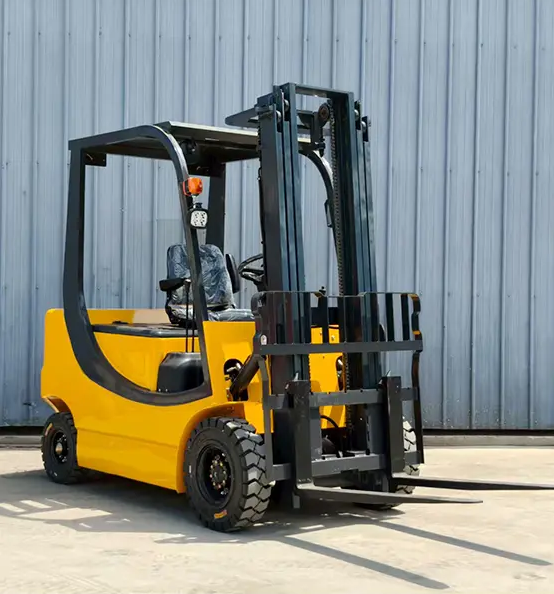
Let's establish a realistic baseline for your capital expenditure. A standard new unit typically runs between $20,000 and $45,000+. This incredibly wide range depends heavily on specific load capacities and engineered mast types. A simple 2-stage mast costs far less than a specialized 4-stage quad mast designed for extreme racking heights. If your budget points toward standard used models, expect current market prices to average around $17,000 for well-maintained equipment.
Next, we must thoroughly deconstruct the dangerous "unbundled" quote. Dealers frequently price the metal chassis completely separate from the actual power source. This entrenched industry standard creates a dangerous illusion of affordability. A procurement manager might receive a seemingly fantastic quote, only to realize weeks later it entirely excludes the battery and charger. We strongly advise all buyers to demand comprehensive, "all-inclusive" quotes upfront to prevent catastrophic budget overruns.
Macro pricing pressures also continue to manipulate equipment availability. Persistent global supply chain bottlenecks have severely delayed new deliveries across major manufacturers. This prolonged scarcity creates a massive premium on immediate-availability used equipment. Desperate warehouse managers often overpay just to get a functional machine on site quickly. Conversely, new equipment pricing feels slightly less intimidating today thanks to modern subscription models. Battery as a Service (BaaS) allows operations to lease the primary power source over time. This financial maneuver lowers the initial barrier to entry significantly and shifts capital from CapEx to OpEx.
Why do 1.5–3 ton electric forklifts represent the ultimate market "sweet spot" right now? They consistently yield the absolute highest conversion rates and best ROI for small-to-medium fulfillment centers. These agile machines perfectly balance raw lifting power with essential warehouse agility.
Let's look at their operational alignment. These specific tonnage models offer an exact dimensional match for handling standard 48×40 warehouse pallets. Furthermore, they excel in highly restrictive narrow-aisle environments. To maximize vertical storage space, modern warehouses frequently shrink their operational aisles from 12 feet down to a mere 8 or 10 feet. This specific size class adapts seamlessly to tighter turning radiuses while still providing a highly sufficient weight-to-power ratio.
Smart procurement teams also leverage high-value technical configurations. We highly recommend specifying a 3-stage mast alongside integrated side-shift attachments. This specific setup typically commands a $1,000 to $2,000 price premium at the dealership. However, warehouse operations routinely see a 20% to 30% immediate boost in daily pallet handling efficiency. The ergonomic upgrade literally pays for itself within a few short months.
Finally, buyers must consider the hidden freight factor. This optimal weight class frequently qualifies for reduced or completely free shipping in modern direct-to-buyer sales models. Eliminating heavy-haul flatbed freight removes an average $800+ purchasing friction point from your final invoice. You retain more working capital inside your core business rather than paying a logistics broker.
Choosing between a brand-new and pre-owned machine often paralyzes procurement teams. You can eliminate this friction using the 4-hour utilization threshold. It serves as an incredibly reliable operator heuristic. If your team actively uses the equipment less than 4 hours a day, a used purchase remains a highly viable and smart financial decision. However, if your facility runs it continuously across multiple overlapping shifts, you must buy new. You must protect your operation from catastrophic mechanical downtime.
Next, you need a framework for calculating the "economic life" of the asset. Industry engineering standards generally define the absolute lifecycle limit around 10,000 hours. A forklift's economic life officially ends precisely when the annualized maintenance costs exceed the annualized cost of a total replacement. To visualize this invisible wear and tear, remember a simple formula. Running a warehouse forklift for just 200 hours equals roughly 3,000 miles of heavy mechanical wear on a standard passenger car.
Let's objectively weigh the feature parity trade-offs. A new electric vehicle delivers advanced safety assist sensors, integrated AI predictive maintenance alerts, and comprehensive multi-year warranty coverage. You pay a premium for total peace of mind. The primary benefit of a used model remains strictly financial. You secure a drastically lower initial capital expenditure and gain immediate site delivery without enduring a six-month factory wait.
Evaluation Metric | Buy New | Buy Used |
|---|---|---|
Daily Utilization | Over 4 Hours (Multi-Shift) | Under 4 Hours (Light Duty) |
Economic Life Left | Full 10,000 Hours | Varies (Check Hour Meter) |
Core Advantage | AI Tech, Safety Assists, Warranty | Lower Capex, Immediate Delivery |
Your chosen battery chemistry ultimately dictates your long-term operational budget. Procurement teams must contrast initial capital against long-term operational drag. Traditional lead-acid batteries always look much cheaper on the initial invoice. Conversely, modern lithium-ion technology carries a notably higher upfront price tag. Many buyers hastily stop their financial analysis right here. This represents a massive miscalculation in modern logistics.
You must thoroughly uncover the hidden lead-acid costs. Lead-acid batteries impose heavy operational burdens daily. By law, they require dedicated, perfectly ventilated charging rooms to prevent hazardous hydrogen gas buildup. Your maintenance team must perform constant, tedious water-level checks to prevent permanent cell degradation. Furthermore, multi-shift operations absolutely require multiple battery swap-outs. You inevitably end up purchasing two or three lead-acid batteries per single machine, erasing the initial savings entirely.
We firmly advocate the massive lithium advantage. Frame lithium-ion as your only strategic choice for high-intensity, demanding environments. It enables "opportunity charging," allowing operators to simply plug the machine in during short 15-minute coffee breaks or lunch periods. It requires absolutely zero daily water maintenance. It also delivers flawless, uninterrupted performance in cold-storage freezers where lead-acid traditionally suffers massive voltage drops. Over a rigorous five-year horizon, lithium-ion heavily dominates the final TCO calculation.
Feature / Requirement | Lead-Acid Battery | Lithium-Ion Battery |
|---|---|---|
Upfront Cost | Lower (Appears cheaper) | Higher (Requires more capital) |
Maintenance Needs | High (Weekly watering, equalization) | Zero (Completely sealed system) |
Charging Strategy | 8-hour charge + 8-hour cool down | Opportunity charging anytime |
Infrastructure Needed | Ventilated battery room required | Plug in anywhere, no venting |
Even highly experienced buyers frequently stumble during final vendor negotiations. We routinely see established companies lose thousands of dollars by ignoring seemingly minor configuration details. You must protect your capital and operational efficiency by actively avoiding these four common pitfalls.
Buying for Today, Not Tomorrow (Capacity Trap): Never spec your load capacity strictly to your current baseline weights. If your heaviest pallet weighs 2,800 lbs today, do not buy a bare-minimum 3,000 lb machine. We strongly recommend securing a 10% to 20% redundancy margin. This built-in buffer accommodates future business expansion and prevents dangerous, long-term equipment strain. Overloading causes premature mast failure.
Ignoring Tire and Terrain Upgrades: Standard dealer quotes assume you run on perfectly smooth indoor concrete floors. If your operation requires outdoor transit across asphalt, or handles uneven gravel terrain, you absolutely need pneumatic or specialized cushion tires. Specifying these heavy-duty traction options can unexpectedly add $1,500 to $4,000 to your final invoice. Catch this discrepancy early in the negotiation.
Overlooking Hydraulic Valve Requirements: Specialized handling attachments like paper roll clamps or carton rotators demand extra hydraulic pathways. Many naive buyers simply purchase standard 3-valve setups. When they try adding complex attachments six months later, they face a mechanical crisis. Retrofitting a 4th or 5th hydraulic valve at a local shop is highly cost-inefficient. Order the correct hydraulic pathways on day one.
Failing to Audit Dealer Support: Negotiating the absolute lowest hardware price only solves half the procurement puzzle. Evaluating local service response times is absolutely critical for your survival. You must explicitly verify local parts availability before signing any long-term contract. A cheap machine becomes incredibly expensive if your crew waits three weeks for a proprietary replacement sensor.
To safely navigate these traps, follow these shortlisting best practices during vendor outreach:
Request fully itemized proposals to spot hidden battery exclusions instantly.
Demand clear lead time commitments documented in writing.
Ask competing dealers for a guaranteed maintenance response Service Level Agreement (SLA).
An electric forklift represents a major, strategic infrastructure investment for your facility. You should never treat it as a disposable warehouse commodity. Proper equipment selection scales your operational efficiency while aggressively driving down long-term overhead costs. Electric fleets drastically lower your carbon footprint while boosting worker morale through silent operation.
Your immediate next steps are clear and highly actionable. First, audit your exact daily run hours to determine your true utilization threshold. Second, finalize your facility's internal electrical capacity. You must ensure your current power grid easily supports rapid charging infrastructure without triggering massive utility demand charges. Finally, approach the commercial market confidently. Request fully itemized, battery-inclusive quotes from at least three different major vendors. Compare their Total Cost of Ownership objectively over a five-year horizon to guarantee your maximum return on investment.
A: A replacement battery typically costs between $2,500 and $5,000. The exact price depends heavily on the chosen chemistry. Traditional lead-acid batteries sit at the lower end of this pricing spectrum. Modern lithium-ion systems cost significantly more upfront but offer zero maintenance routines and dramatically longer lifespans.
A: Yes, they are substantially cheaper to maintain. Electric models feature roughly 90% fewer moving parts than internal combustion engines. You eliminate oil changes, transmission flushes, and spark plug replacements entirely. Additionally, electric units require routine maintenance every 500 hours, whereas propane or diesel models require costly servicing every 200 hours.
A: You can successfully use them outdoors, provided you configure them correctly. You must specify appropriate weatherproofing standards to protect sensitive electrical components from rain and dust. Furthermore, outdoor usage typically requires pneumatic tires to handle uneven terrain safely. Always verify your specific weight limitations regarding outdoor yard ramps.
A: Under proper maintenance schedules, the economic lifecycle of a standard unit reaches approximately 10,000 hours. Beyond this critical 10,000-hour threshold, the annualized cost of mechanical repairs and part replacements generally exceeds the financial cost of purchasing a brand-new replacement vehicle.


