

Views: 0 Author: Site Editor Publish Time: 2026-07-03 Origin: Site
Moving away from internal combustion engines and legacy lead-acid batteries represents more than a simple sustainability trend. It stands as a mandatory operational upgrade for modern, multi-shift logistics facilities. Industry leaders face immense pressure to accelerate supply chain velocity. Legacy systems slow you down through forced maintenance downtime and power inefficiencies. You need reliable power to maintain continuous operations.
Scaled production changes this entire operational dynamic. Direct access to a modern manufacturing hub significantly drives down upfront capital expenditure. This makes long-term financial modeling undeniably favorable for large fleets. You can now align equipment capabilities directly with demanding labor schedules.
We designed this guide to help you navigate these critical shifts. It provides procurement and operations leaders with a definitive evaluation framework. You will learn how to rigorously assess fleet adoption, mitigate implementation risks, and evaluate manufacturer partnerships. Read on to master the strategy behind modernizing your material handling operations.
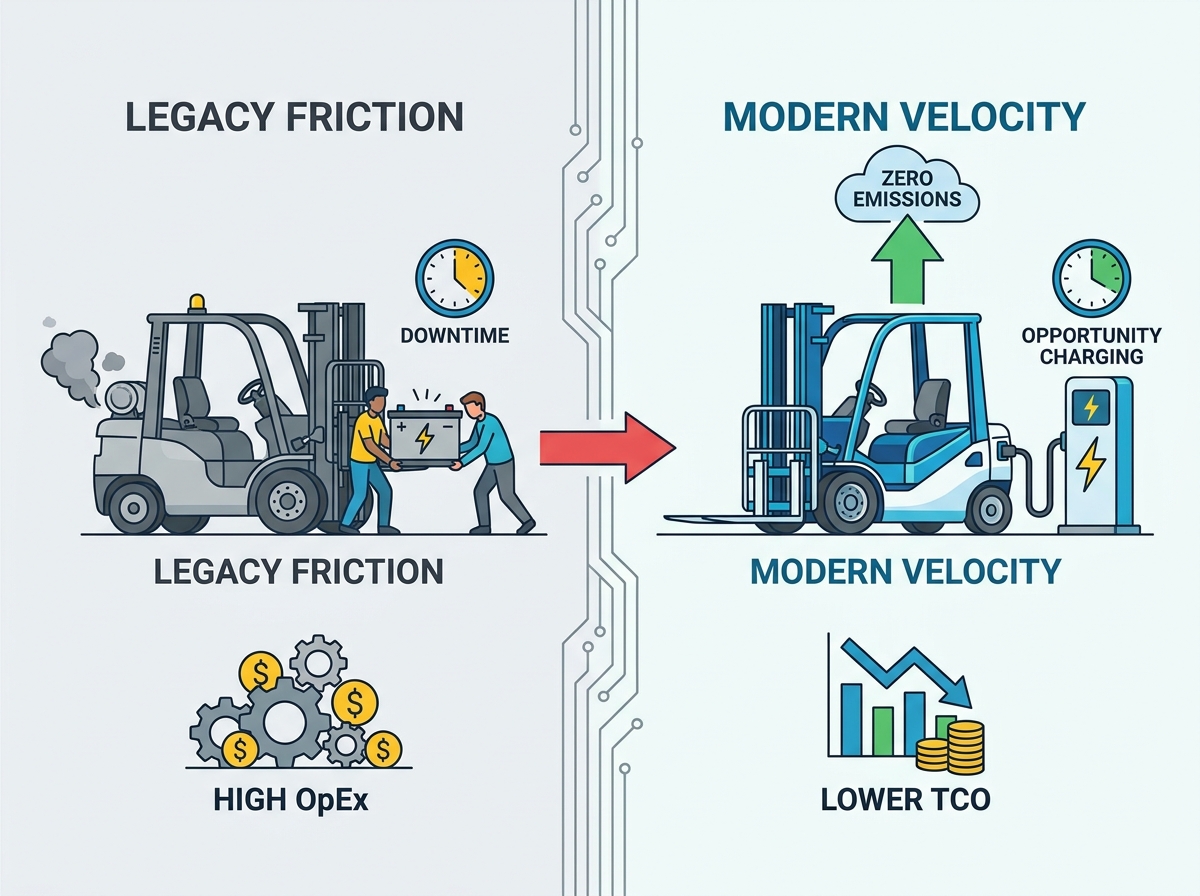
TCO Inversion: Lithium adoption shifts material handling costs from high OpEx (maintenance, battery swapping) to predictable, lower long-term TCO.
Operational Velocity: Opportunity charging eliminates multi-battery requirements and swap-related downtime.
Infrastructure Hurdles: Facility electrical capacity and charging station placement are the primary friction points in adoption.
Procurement Shift: Direct access to Tier-1 factory output ensures integrated Battery Management Systems (BMS) and enforceable warranties.
Logistics facilities historically relied on outdated power architectures. These legacy solutions create massive hidden costs for daily operations. Lead-acid batteries require dedicated maintenance rooms. Operators must endure mandatory cool-down periods. Internal combustion engines introduce severe fuel price volatility. These older methods actively fight against operational efficiency.
Common friction points associated with legacy fleets include:
Dedicated floor space wasted on sprawling battery exchange rooms.
Constant daily labor hours lost to manual battery watering tasks.
Safety hazards caused by acid spills and heavy lifting during battery swaps.
Unpredictable fuel expenses for internal combustion models.
Modern e-commerce and high-velocity supply chains operate around the clock. You cannot afford equipment downtime. Multi-shift operations demand machinery capable of running seamlessly from morning until midnight. Forklifts must match the intense pace of contemporary fulfillment centers. A single hour of sidelined equipment translates into immediate revenue loss.
The warehouse battery forklift evolution directly resolves these persistent pain points. Integrated lithium models align equipment availability with your actual labor shifts. They remove the need for lengthy cool-down cycles. You keep your machines on the active warehouse floor where they belong. This ensures continuous material flow and dramatically improves worker productivity.
Early adoption phases often involved modifying old equipment. Many companies retrofitted heavy lead-acid chassis to accept new battery cells. This approach compromised vehicle stability. A purpose-built chassis fundamentally changes vehicle dynamics. True integration ensures superior weight distribution. Operators experience vastly improved ergonomics and handling characteristics.
Sourcing directly from a top-tier lithium electric forklift factory unlocks major cost reductions. High-volume manufacturing lines stabilize global supply chains. Factories produce standardized components like Lithium Iron Phosphate (LFP) cells at scale. This standardization aggressively reduces your initial acquisition costs. You receive higher-quality equipment without the inflated boutique pricing.
Advanced drivetrains differentiate modern equipment from direct current (DC) predecessors. A fully integrated AC lithium forklift utilizes alternating current technology. This delivers highly precise torque control. Operators maneuver heavy loads smoothly in tight aisles. These systems also feature regenerative braking. Regenerative braking feeds energy back into the power cell during deceleration. It significantly lowers mechanical wear on physical brake components. Your maintenance teams spend less time replacing worn brake shoes.
You achieve peak operational velocity through opportunity charging. Operators can safely plug in their machines during standard 15-to-30-minute breaks. This brief charging window completely eliminates the traditional 8-8-8 lead-acid cycle. The old cycle forced eight hours of operation, eight hours of charging, and eight hours of cooling. Opportunity charging breaks this rigid schedule. Your equipment remains continually ready.
Consistent power delivery guarantees sustained productivity. Lead-acid systems suffer from voltage drops as their charge depletes. Forklifts become sluggish near the end of a shift. Lithium voltage remains perfectly stable until full depletion. Operators enjoy maximum lifting speed and travel velocity throughout the entire workday.
Upfront capital expenditures often look intimidating. However, you must evaluate operational expenses (OpEx) comprehensively. Modern power systems eliminate expensive battery watering labor. You no longer need to build and ventilate specialized charging rooms. You also avoid purchasing redundant replacement inventory. A single power cell supports the machine throughout its working life.
Asset lifespans heavily favor advanced chemistry. A standard lead-acid unit typically dies after 2,000 charge cycles. Commercial lithium packs routinely exceed 3,000 cycles. You buy fewer replacement units over a ten-year operational horizon. This extended longevity transforms the financial realities of fleet management.
Battery Architecture Performance Profile
Performance Metric | Legacy Lead-Acid | Modern Commercial Lithium |
|---|---|---|
Typical Cycle Life | 1,500 - 2,000 cycles | 3,000+ cycles |
Power Delivery | Degrades as charge lowers | Consistently high until depleted |
Charging Methodology | Lengthy swap & cool-down required | Fast opportunity charging |
Maintenance Requirement | High (watering, equalizing) | Zero (sealed unit) |
Corporate sustainability mandates now dictate major procurement decisions. Stakeholders demand strict zero-emission strategies. Electrifying your fleet directly supports corporate Environmental, Social, and Governance (ESG) goals. Tightening carbon reporting requirements leave little room for heavily polluting equipment. You must document clear reductions in your facility carbon footprint.
Enclosed environments magnify the importance of indoor air quality. Internal combustion models pose severe carbon monoxide risks. Old battery types threaten workers through potential acid spills. Choosing an eco-friendly counterbalance forklift provides the optimal solution. These machines run cleanly. They eliminate harmful exhaust fumes entirely. Your workers breathe safer air.
Navigating regulatory compliance becomes significantly easier. Local jurisdictions increasingly restrict hazardous material storage. Proper ventilation requires expensive infrastructure upgrades. An indoor handling forklift powered by advanced cells simplifies OSHA compliance. You bypass strict regulations governing explosive gas ventilation and hazardous acid handling. This protects your operation from surprise fines and costly compliance audits.
Many rollouts fail due to poor infrastructure planning. Inadequate facility grid capacity stands as the most common adoption hurdle. High-speed chargers draw substantial electrical currents. You must execute careful peak-load assessments before ordering equipment. Utility upgrades often take months to complete. Engaging your local power provider early prevents frustrating deployment delays.
Effective implementation follows these structured steps:
Audit current electrical grid capacity across all operating zones.
Identify peak usage times to prevent facility-wide power failures.
Map out decentralized charging locations near break rooms.
Establish clear behavioral guidelines for equipment operators.
Charger placement strategy dictates your operational flow. You should avoid centralizing all chargers in one location. This creates traffic bottlenecks during shift changes. Decentralize charging stations strategically. Place them near staging areas or cafeterias. This encourages operators to plug in seamlessly during natural breaks without traveling across massive warehouse floors.
Operator change management requires dedicated training. Workers spent decades learning to run batteries down to zero before swapping them. They must unlearn this habit. Enforce frequent, short charging sessions. Educate your team on how opportunity charging actually protects the equipment. Positive reinforcement helps operators embrace these new daily routines.
You must scrutinize potential manufacturing partners ruthlessly. Demand absolute transparency regarding the Battery Management System (BMS). The BMS functions as the brain of the power unit. You need open access to telematics data. Fault reporting, temperature monitoring, and cell balancing data must remain visible to your maintenance teams. Hidden or encrypted diagnostics hold your operations hostage.
Read factory warranties with deep skepticism. Understand exactly what exclusions void the guarantee. Manufacturers often specify strict temperature operating ranges. They might penalize you for using unauthorized third-party chargers. Clarify these boundaries during the negotiation phase. You want enforceable warranties covering realistic warehouse conditions.
Aftermarket support prevents devastating downtime. Do not create an "orphan fleet" by choosing an unsupported brand. Verify local parts distribution channels before signing contracts. Ensure your manufacturing partner employs certified technicians in your geographical region. Rapid response times guarantee your machines stay productive when rare hardware failures occur.
Transitioning away from legacy power architectures requires thorough budgetary justification. Upfront capital investments can initially challenge procurement departments. However, the resulting operational yield clearly makes advanced electrification the baseline for competitive logistics. You gain unprecedented equipment uptime. You eliminate hazardous maintenance tasks. You secure a safer, more productive working environment for your entire team.
Take proactive steps immediately. Initiate a comprehensive facility power audit to understand your true electrical capacity. Request a detailed lifecycle financial comparison model from your shortlisted manufacturers. Engage your warehouse managers to map out optimal charging station locations. By executing these steps, you build a resilient, future-proof logistics operation.
A: A high-quality commercial pack typically lasts between seven and ten years. This translates to roughly 3,000 to 5,000 charging cycles. They maintain high capacity retention rates even after years of heavy use. Proper opportunity charging protocols maximize this lifespan and prevent premature cell degradation.
A: You must conduct a professional electrical load study first. Fast-charging stations require significantly higher amperage than standard overnight chargers used for older equipment. Many older facilities need localized grid upgrades or smart-charging software to safely distribute power without tripping main breakers.
A: Yes, they perform exceptionally well in extreme cold. Premium factory outputs feature integrated thermal management systems. Built-in battery heaters maintain internal cell temperatures. This preserves charging efficiency and discharge rates while operating inside industrial freezers or cold storage warehouses.
A: End-of-life units rarely go to landfills. Factories often repurpose them for second-life applications. They serve effectively as stationary energy storage for commercial solar grids. Furthermore, dedicated recycling programs recover valuable metals, strongly reinforcing the original ESG value proposition.


