

Views: 0 Author: Site Editor Publish Time: 2026-03-16 Origin: Site
Contractors entering the construction equipment market often see a Wheel Excavator as a versatile solution for urban and roadside work. The machine looks flexible and capable, yet first-time buyers frequently focus too heavily on price or overall size while overlooking practical factors such as road mobility, stability systems, attachment compatibility, and jobsite conditions. These details ultimately determine whether the machine performs efficiently or becomes underutilized. A well-chosen wheel excavator can travel quickly between worksites, reduce transportation costs, and handle a wide variety of tasks from trenching to material handling. This guide explains the essential considerations beginners should understand before purchasing their first machine so they can match equipment capability with real jobsite requirements.
One of the defining characteristics of wheeled excavators is their ability to travel on roads without requiring specialized transport vehicles. Unlike tracked machines that must often be loaded onto trailers for relocation, wheeled units can drive directly between nearby worksites. This mobility allows operators to begin work faster and reduces logistical planning.
For contractors who manage multiple short-distance projects each day, this feature dramatically improves workflow. A machine capable of traveling independently between sites reduces idle time and eliminates the need for additional hauling equipment.
Wheel excavators perform particularly well on paved surfaces and mixed terrain environments. Rubber tires allow the machine to move efficiently across asphalt, concrete, and compact soil without damaging the surface.
In urban construction environments where protecting finished surfaces is important, wheeled machines offer a significant advantage compared with steel tracks.
Because of their mobility and reduced surface impact, wheel excavators are widely used in municipal projects. Road maintenance crews, utility installation teams, and city infrastructure contractors frequently rely on these machines for trenching, repair work, and material handling tasks in crowded urban areas.
Their ability to move easily between locations allows crews to maintain productivity even when projects require frequent relocation.
Utility installation is one of the most common applications for wheel excavators. Water pipes, electrical cables, and communication lines often run beneath city streets, and contractors must dig trenches without disrupting surrounding infrastructure.
Wheeled excavators provide the precise hydraulic control necessary for trenching while allowing operators to reposition quickly along the street.
Municipal roadwork projects require machines capable of working close to traffic and infrastructure. Wheel excavators are particularly useful for curb repair, drainage maintenance, and asphalt removal because they can operate safely in confined areas while maintaining good maneuverability.
City maintenance teams frequently handle tasks ranging from tree removal to drainage installation. Wheel excavators equipped with grapples or buckets allow crews to perform these tasks efficiently without transporting multiple machines.
Wheel excavators also excel at lifting and moving materials on paved surfaces. Construction materials such as pipes, debris, or aggregates can be handled efficiently without damaging roads or finished ground surfaces.
Compact wheel excavators in the 8 to 10 ton range are designed for maximum maneuverability. These machines are well suited to narrow streets, landscaping projects, and light construction work.
Their smaller footprint allows them to operate comfortably in tight spaces while still delivering adequate digging force for everyday tasks.
The 14 to 16 ton class is often considered the most balanced category for contractors who require both mobility and strong performance. Machines in this class provide deeper digging capability and improved lifting stability while remaining practical for urban environments.
This class is widely used for general construction, municipal projects, and utility installation.
Larger wheel excavators in the 20 to 23 ton range offer significantly greater lifting capacity and hydraulic power. These machines are ideal for heavy construction tasks, deeper excavation work, and material handling operations that require stronger performance.
While larger machines provide more power, they may not always be the best choice for every contractor. Oversized equipment often increases fuel consumption, purchase cost, and transport complexity. When the machine is larger than necessary for the job, its productivity advantages may not offset these additional costs.
Selecting equipment that matches real project requirements ensures better efficiency and return on investment.
Wheel excavators can travel significantly faster than tracked machines. Higher travel speeds allow operators to move between work areas without additional transportation equipment.
For contractors handling multiple projects in a single day, this mobility can save considerable time.
Tires influence traction, ride comfort, and durability. Machines working primarily on paved roads may use road-optimized tires designed for smoother travel and longer wear life.
Projects involving mixed terrain may require all-terrain tire designs that provide stronger traction on gravel or soil.
Urban construction environments often include narrow streets and limited operating space. A machine with a tight turning radius allows operators to maneuver safely around obstacles such as buildings, parked vehicles, and traffic barriers.
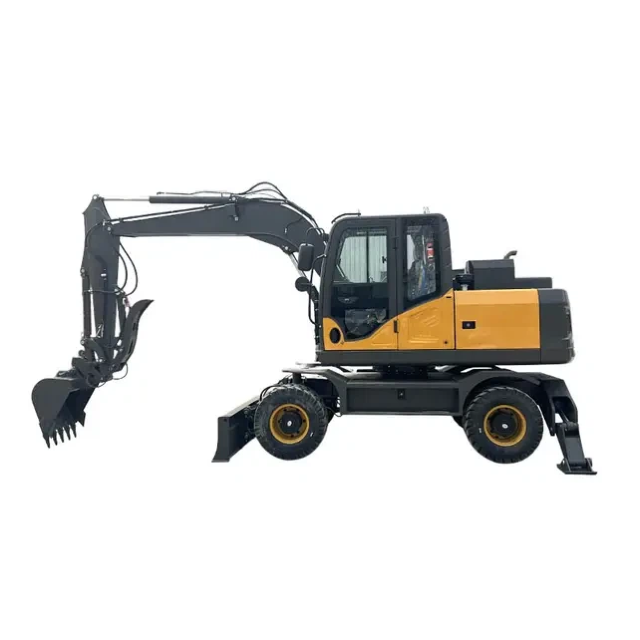
Outriggers provide additional stability during lifting or digging operations. When deployed, they extend outward from the machine and transfer weight to the ground, reducing the risk of tipping.
This feature is especially important when handling heavy loads or operating attachments such as hydraulic breakers.
Hydraulic control determines how accurately the excavator performs tasks. Smooth hydraulic response allows operators to perform delicate movements when working near infrastructure such as pipelines or cables.
Precise control improves both safety and productivity.
Attachments expand the versatility of wheel excavators. Breakers, grapples, augers, and compactors require auxiliary hydraulic circuits to function properly. Buyers planning to use multiple attachments should ensure that the machine supports adequate hydraulic flow.
Urban construction often takes place near traffic and pedestrians. A machine with large windows and clear sightlines allows operators to monitor surroundings and avoid hazards.
Good visibility improves safety and helps operators maintain precise control.
Ergonomic control layouts reduce operator fatigue during long workdays. Intuitive joystick placement and responsive controls allow operators to perform repetitive movements comfortably.
Climate control systems help maintain comfortable working conditions during extreme weather. Noise insulation reduces fatigue, while optional cameras enhance visibility around the machine.
These features contribute directly to operator efficiency and safety.
Reliable equipment operation requires access to spare parts and technical documentation. Clear manuals and responsive technical support ensure that maintenance tasks can be performed correctly.
Construction projects often operate under strict timelines. Equipment suppliers capable of delivering machines quickly help contractors avoid project delays.
Quality testing before shipment ensures that hydraulic systems, engines, and control systems operate correctly. Thorough inspection reduces the likelihood of early mechanical issues after delivery.
Loongsheen engineers evaluate working conditions before recommending equipment configurations. By understanding jobsite conditions and project requirements, the company helps buyers select machines suited to their operations.
Different projects require different attachments. Loongsheen provides a range of attachment solutions designed to expand machine versatility and improve efficiency across various applications.
The company offers flexible trade terms and payment options that support international customers. Competitive pricing combined with reliable manufacturing makes equipment acquisition more accessible.
Machines are produced at the company’s manufacturing facility in Jining, Shandong. Efficient production processes and global logistics networks help ensure timely delivery to international customers.
Buying Factor | Why It Matters | What Beginners Often Miss | Loongsheen Solution |
Machine Size | Determines power and stability | Buying machines larger than necessary | Multiple size options |
Mobility | Saves time between jobsites | Ignoring travel speed | Road-ready designs |
Hydraulic System | Enables precise control | Underestimating hydraulic performance | Advanced hydraulic engineering |
Attachments | Expands machine capability | Not planning attachment use | Custom configuration |
Delivery and Support | Ensures reliable operation | Overlooking after-sales support | Global service network |
Understanding the essential features of a wheel excavator helps beginners make informed purchasing decisions. Instead of focusing only on price or machine size, buyers should consider mobility, hydraulic performance, attachments, and long-term support. When these factors align with project requirements, a well-chosen wheeled excavator becomes a powerful tool for improving efficiency and productivity across urban construction and municipal work.
Loongsheen is a professional manufacturer and exporter of heavy construction equipment including excavators, skid steer loaders, road rollers, mini dumpers, and truck cranes. Located in Jining, Shandong, the company develops machines designed for demanding construction environments worldwide. If you would like to learn more about our wheel excavator models or discuss the right configuration for your projects, contact our team for detailed product information and global delivery options.
Wheel excavators are ideal for urban construction because they can travel on roads without damaging surfaces and move quickly between nearby worksites.
Selecting the right size depends on project requirements. Smaller machines provide better maneuverability, while larger machines offer stronger digging power and lifting capacity.
Yes. Many wheel excavators support attachments such as buckets, breakers, grapples, and augers through auxiliary hydraulic circuits.
Unlike tracked machines, wheel excavators can travel on roads independently, reducing the need for transport trailers between nearby worksites.


